

This is a complete list of creator and gaming laptops with high-resolution, high-refresh 4K displays, from 4K 120Hz up to 4K 240Hz as of this latest update. It includes the latest IPS, miniLED, and OLED panel options, among the different available implementations.
Most gaming laptops these days ship with fast screens, with refresh rates of 240/360 Hz or, more recently, even 480 Hz. However, most of these options are 2K (1920 x 1200 px) or 2.5K (2560 x 1600 px) in resolution, which is fine for most configurations and most gamers, but might not suffice for the enthusiasts looking for the most powerful gaming laptops and the sharpest of details, or for the most competent work companion with the best display possible.
In recent years, performance laptops with 4K 240Hz and 4K 120Hz screen options have also been launched, as well as mid-range options with QHD resolution and 165-240Hz refresh rates, which are a topic for another article. This one is all about the laptops available with UHD 4K displays.
Razer were the first to offer a 4K 120Hz screen option back in the day for their retail Blade Pro 17, even if Asus initially mentioned it for the ROG Zephyrus GX701 and their StudioBook One workstation. Other OEMs followed up quickly, and while the offer for such computers is still limited today, there are at least a handful to choose from. In recent years, more modern 4K UHD 240Hz and 144Hz panels are offered in several of these premium-tier devices, as well as 4K OLED 120Hz options (Mostly Tandem OLED, in fact).
Several panel manufacturers make this sort of fast 4K screens, available in either 14-inch, 16-inch, 17-inch, or 18-inch sizes. All of them are high-gamut, with close to 100% coverage of the DCI-P3 and AdobeRGB color space and factory calibrated in most configurations, as well as above-average in brightness (500+ nits), rich contrast and blacks, but also 120/144/240 Hz refresh rates and fast response times (advertised at as low as 3ms). That’s why these 4K screens are not just meant for gaming, but they’re actually excellent tools for creators and professionals who require a color-accurate display in their line of work.
So while in the past you could only have one or the other: either a fast FHD screen, or a 100% AdobeRGB UHD screen at 60 Hz, now you can have both fast refresh rates and 4K-UHD resolution in a single product. That’s if you’re willing to pay the hefty price tag, of course, which is roughly several hundred dollars on top of the FHD/QHD variants. In fact, you’ll probably pay even more, as these 4K screens are most of the time only available on the highest-tier notebook configurations.
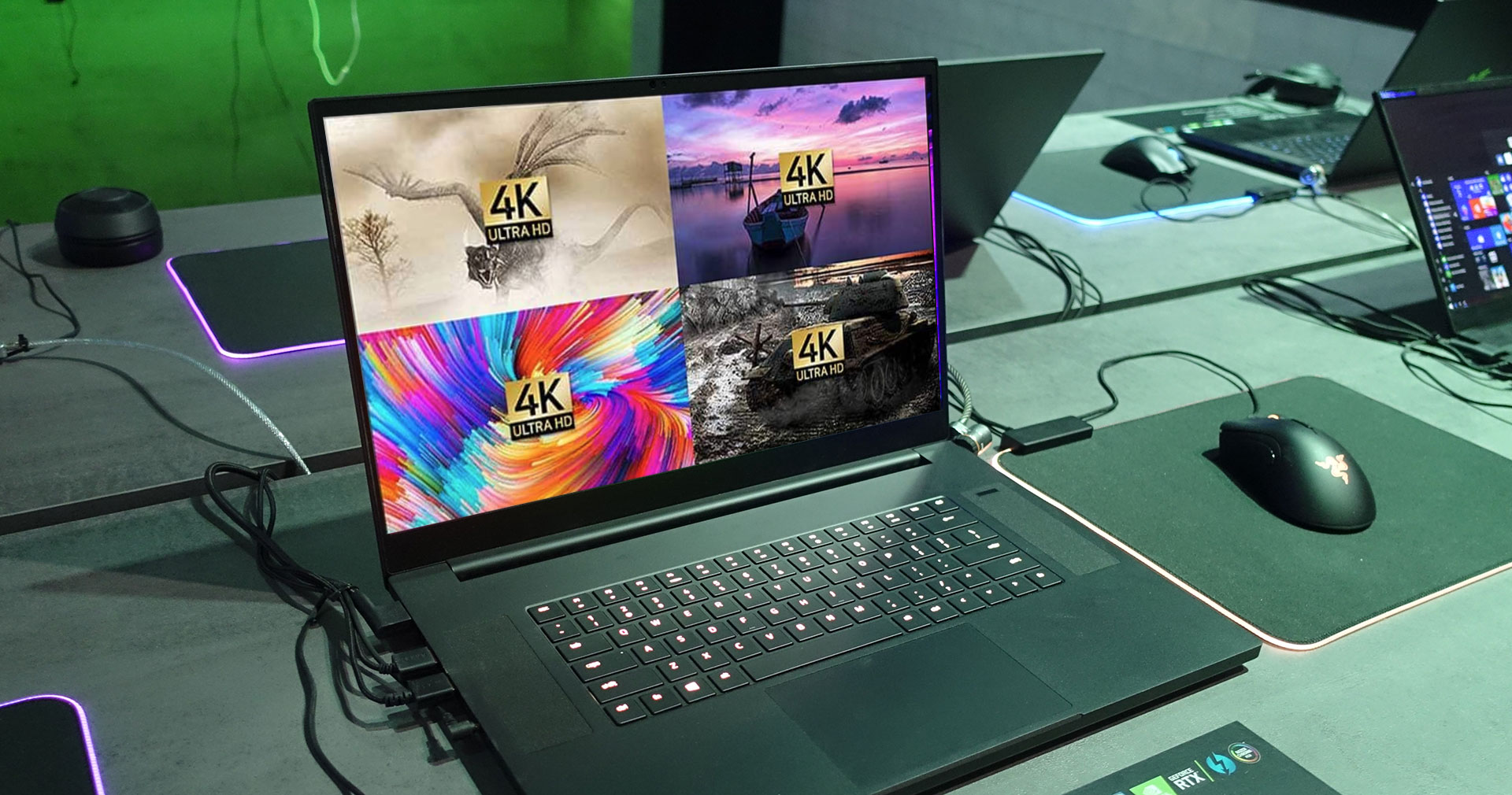
The Blade 17 was among the first gaming laptops announced with the 4K 120Hz panel with 100% AdobeRGB color coverage
And there’s one more reason these 4K 240/120 Hz screen options only make their way into the highest-end configurations of the highest-end performance and gaming notebooks out there: it takes beastly hardware to run modern games at high details and 60++ frame rates, in order to justify gaming on this kind of a display.
That actually means that most OEMs only offer this screen option alongside higher-tier RTX graphics, or the equivalent Quadro/Pro options for workstations. And even if you can find the high-res, high-refresh screen on a mid-tier system, I’m not sure I’d recommend it for gaming anyway, due to the hit in graphics performance at this resolution over QHD – you’ll most likely end up running games at a non-native resolution or with lower graphics settings.
The complete list of gaming/creator laptops with 4K display (high refresh 240Hz, 144Hz, or 120Hz)
We’re keeping our eyes peeled in order to update the list below as more options are being announced, but so far, here are all the laptops that you can get with 4K UHD 120Hz and 144Hz screens right now. And if you spot anything that should be in here and is not, make sure to tell us about it in the comments section down below. Thanks!
The latest models implement the most advanced technologies of the moment, such as IPS or miniLED displays, Nvidia Blackwell graphics with up to RTX 5090 dGPUs, and the most powerful platforms from Intel or AMD.
As of 2026, there is a new-gen 14-inch and 16-inch 4K 120Hz OLED panel available on select ultraportables. However, 4K 120Hz or higher OLED panels are not yet offered in larger sizes in performance/gaming devices.
Note: I took out some of the older options from the list and only left those that are available in stores today.
| Model (link to reviews) | Hardware | Screen | Price (4K model) |
| Acer Predator Helios 18 AI | Intel Core Ultra HX + up to RTX 5090 175W | 18″ mini LED 4K 120Hz, matte, MUX | – |
| Asus ProArt P16 | AMD Ryzen AI 9 + up to RTX 5090 130W | 16″ Tandem OLED 4K 120Hz, touch | from $3999 |
| Asus ROG Strix Scar 18 | Intel Core HX + RTX 5090 175W | 18″ mini LED 4K 240Hz, matte, MUX and Advanced Optimus |
from $4999 |
| Dell Pro 16 Premium | Intel Core Ultra H + Arc | 16″ Tandem OLED 4K 120Hz, touch | – |
| Dell Pro Precision 7 | Intel Core Ultra H + Arc | 16″ Tandem OLED 4K 120Hz, touch | – |
| Eurocom Raptor X18 | Intel Core HX + up to RTX 5090 175W | 18″ IPS 4K 200Hz, matte, MUX | from $4259 |
| Zbook Fury G1i 16 | Intel Core Ultra HX + RTX Pro 5000 | 16″ IPS 4K 120Hz, matte | – |
| HP ZBook Ultra G3a | AMD Ryzen AI 9 + Radeon | 16″ mini LED 4K 120Hz, anti-glare, touch | from $3999 |
| Lenovo Legion 9i 18 | Intel Core Ultra HX + up to RTX 5090 175W | 18″ IPS dual-spec 4K 240Hz or 2K 440Hz, matte, MUX |
from $3999 |
| Lenovo Yoga Pro 9i Aura Edition |
Intel Core Ultra H + RTX 5070 | 16″ Tandem OLED 4K 120Hz, touch | from $2269 |
| Lenovo Yoga Slim 9i | Intel Core V + Arc | 14″ OLED 4K 120Hz, touch | from $1749 |
| MSI CreatorPro X18 HX | Intel Core HX + up to RTX 5000 Ada 175W | 18″ mini LED 4K 120Hz, matte, MUX | from $3499 |
| MSI Raider 18 HX AI | Intel Core HX + up to RTX 5090 175W | 18″ mini LED 4K 120Hz, matte, MUX | from $2999 |
| MSI Raider A18 HX | AMD Ryzen HX + up to RTX 5090 175W | 18″ IPS 4K 120Hz, matte, MUX | from $2599 |
| MSI Stealth 16 AI Studio | Intel Core HX + up to RTX 4090 105W | 16″ mini LED 4K 120Hz, matte, MUX | from $2799 |
| MSI Stealth 18 HX | Intel Core HX + up to RTX 5090 150W | 18″ mini LED 4K 120Hz, matte, MUX | from $2499 |
| MSI GT77 Titan | Intel Core HX + up to RTX 4090 175W | 17.3″ mini LED 4K 144Hz 3ms, matte, MUX | – |
| MSI Titan 18 HX AI | Intel Core HX + up to RTX 5090 175W | 18″ mini LED 4K 120Hz, matte, MUX | from $4999 |
| Razer Blade 16 | older Intel Core HX + up to RTX 4090 175W | 16″ mini LED dual-spec 4K 120Hz or 2K 240Hz, matte, MUX |
from $4399 |
| Razer Blade 18 | Intel Core HX + up to RTX 5090 175W | 18″ IPS 4K 240Hz, matte, MUX |
from $3499 |
| Schenker Key 18 Pro | Intel Core HX + up to RTX 5090 175W | 18″ mini LED 4K 120Hz, matte, MUX | – |
These aside, there’s also a larger selection of laptops available with 4K 60 Hz OLED or IPS screens, also excellent choices for creators, but less so for gaming. We haven’t included those here, but if you’re interested in OLED laptops, you’ll find more about them via this link.
That aside, there are also a few laptops with 120Hz and 240Hz OLED displays available on the market right now, from Asus or Lenovo, but those are 2.8K 120Hz OLED panels, not 4K; thus we will not go over them in this article. For the time being, there are no 4K high-refresh OLED laptop panels, but they might come in the near future.
Also, I for one, am far more interested in the fast and good-quality QHD panels available these days at either 15 or 17 inches, which we’ll cover in a separate article. They’re just better balanced for the hardware available in laptops today, more affordable, and still versatile enough at 100% DCI-P3 color coverage in most cases, and 300++ nits of brightness.








Saas
July 22, 2020 at 4:11 pm
Do you have any information if Asus is planning to upgrade ProArt 17inch notebooks (Pro and Pro X) with 4k option anytime soon?
Andrei Girbea
July 22, 2020 at 4:17 pm
I haven't heard anything about that. I'd reckon it should happen eventually, now that there's a 17-inch 16:10 UHD panel out there (on the XPS 17), but I don't know when they could secure that
Saas
July 22, 2020 at 5:01 pm
Yes I posted this question exactly because of 2020 Dell XPS 17" 16:10 UHD (4K) release. I would expect Asus to rival this with similar panel in 17" ProArt notebooks.
Matt
December 2, 2021 at 9:35 am
Have you had any feedback on the MSI Creator 17? I am interested in a larger 4K 120hz laptop on the slimmer side with good gaming performance. It has lower TDP at 95W, but I would consider making the sacrifice in gaming horsepower if it has a high-quality display that stands out from the rest of the pack. The MSI Z16 appears to bring that to the table, and I am wondering if MSI is carving out a competitive advantage here that is carrying over to the 17" lineup.
Andrei Girbea
December 2, 2021 at 12:49 pm
I haven't tested the 2021 model, only the 2020: https://www.ultrabookreview.com/40683-msi-creator-17-review-miniled/ I also haven't tested the 16 either. Seems very expensive, though, the 16-inch model
Hakan
October 5, 2022 at 3:50 pm
I'm reading this on an HP Zbook Studio G8 with a 4K 120 Hz panel, so this laptop should be added if you want your list to be complete.
The screen is excellent: 15.6", matte, very bright (600+ nits), P3 colours. My only small complaint is that the black level is kinda high (not truly black), which means that contrast is only around 1000:1.
The current model is G9: hp.com/us-en/workstations/zbook-studio.html
Altandmain
May 4, 2025 at 8:42 am
Apparently Dell has a 16" Tandem OLED with a 4k 120Hz panel coming out later this year (likely around July or later with the Blackwell generation of workstation CPUs).
notebookcheck.net/Dell-Pro-Max-16-Plus-and-Dell-Pro-Max-18-Plus-announced-with-RTX-Pro-Blackwell-GPUs-tandem-OLED-panel-and-CAMM-memory-support.981358.0.html
As it is a tandem OLED, we might see brightness of over 1000 nits in HDR, which is comparable to current tandem OLED displays (Lenovo has a 1,600 nit tandem OLED laptop coming out in June, a 16" 3.2k unit).
These are workstations, as opposed to gaming machines, something to keep in mind. The only bottleneck now is that this generation of GPUs is not powerful enough to run modern games at top settings at 4k 120Hz.