We’re discussing the Lenovo Legion 7a series in this detailed review article.
This is a newer model in the Legion lineup for 2026, as more compact and lighter-weight than the other options, while still offering the premium build, design, and ergonomics expected from a 7-series device, which includes Lenovo’s higher-tier notebooks.
The 7a moniker means this is built on an AMD Ryzen hardware platform, alongside Nvidia RTX 5000 graphics. Thus, this Legion 7a aims to be a competitive all-purpose jack-of-all-trades, with mid-level performance in demanding loads, but snappy capabilities for daily use, as well as better efficiency than other Legions built on more powerful Intel HX and Ryzen HX platforms.
Furthermore, this is also Lenovo’s most affordable 7-series Legion at this point. Follow this link for updated configurations and prices on the Legion 7a in your region at the time you’re reading the article.
I’ve used this laptop for a while and gathered my thoughts and impressions in the review below, where I’m also comparing it to the larger, more powerful Legion variants, as well as similar premium portable options offered by Lenovo in the Yoga series (the Yoga Pro 7i and Pro 9i), as well as those offered by the competition.
Specifications as reviewed – Lenovo Legion 7a multimedia laptop
2026 Lenovo Legion 7a 16AGP11, gen 11
Display 16-inch, 16:10, glossy, non-touch,OLED QHD+ 2560 x 1600 px , 240 Hz 1ms,
Processor AMD Gorgon Point Ryzen AI Series 400,
Video AMD Radeon 890M + Nvidia GeForce RTX 5060 Laptop 8GB graphics (up to 115W with Dynamic Boost)
Memory 32 GB LPDDR5x-8533 RAM (onboard), max 64 GB
Storage 1 TB SSD (UMIS) – 1x M.2 4.0 x4 (2242), 1x M.2 PCIe 4.0 x2 (2280)
Connectivity WiFi 7 (Realtek 8922E-VP) 2×2 with Bluetooth 5.4
Ports Left: 1x USB-A 3.2 gen1, 2x USB-C 4.0, audio jack
Battery 84Wh, 245 W power adapter, USB-C charging up to 140W
Size 361 mm or 14.23” (w) x 254 mm or 10.01 (d) x 15.5 – 16.9 mm or .61″ – .67” (h)
Weight 1.82 kg (4. lbs),
Extras clamshell 16-inch format with 180-degree screen angle, full metal chassis,
Design and construction This Legion 7a is one of my favorite chassis available in this niche of premium and portable all-purpose laptops with a full-size 16-inch display, where devices such as the MacBook Pro 16, Asus Zephyrus G16 and ProArt P16, Razer Blade 16, or the Lenovo Yoga Pro 9i compete, to name just some of the popular ones that come to mind. Ergonomics are what mostly set this apart from the other options, as you’ll see in a bit.
The build quality is solid overall, with a sturdy metal main chassis and a sturdy lid. The underbelly, however, is a thinner sheet of metal and creaks sometimes when grabbing the laptop.
All the aluminum parts are softly coated, feel very nice to the touch, and hardly show any smudges or finger oil on this color. They do show dirt, though, and I’d expect that micro-grill under the display to gather dust and dirt over time and end up rather difficult to clean.
Now, in theory, you can get this Legion 7a series in either white or dark blue, but mostly this Glacier White variant is available in stores. That further adds to the uniqueness of this series, but at the same time limits its appeal for potential buyers who would rather not buy a white computer. Ideally, both color options should be more widely available.
The design is somewhat hit and miss for me, with a clean interior (once you peel off those stickers at the right), but not my favorite lid with that big dark-chromed LEGION writing in the middle that stands out too bluntly on this white variant – a more subtle logo in a corner would look nicer. There’s no RGB of any kind, and when it comes to its overall size, this 7a model is more compact, thinner, and lighter than the other Legions, including the Legion 7i. It’s slimmer and lighter than the mid-tier Legion 5a model as well .
The sides are still the brushed bare-aluminum finish previously seen on the Legion 7i, but the actual edges are slightly dulled now and made from the same softer white finish used for the main chassis and the lid. That makes them more comfortable on the wrists than on the Legion 7i. Just keep in mind that this white coating is painted aluminum nonetheless, so you’ll want to treat the laptop as nicely as possible to prevent chips and scratches, especially around the corners and edges.
Now, about the ergonomics, I already mentioned the sturdy and nice metal materials, and I’ll add the roomy interior and the friendly blunted edges and corners all around. The hinges add to the overall premium experience; they’re soft and easy to operate with a single hand, and allow opening the display all the way flat to 180 degrees. However, I would say they’re a little weak past a given point, which means the screen can move out of place if you pick up the laptop and move it around with the display open. But they’re still at an acceptable level overall.
One thing that must be mentioned and bothers me on all Legions is the always-on lit power button placed in the top-middle part of the chassis, under the display, styled as the Legion O logo. This lights in various colors based on use mode and power profile, but still cannot be switched off entirely (or I couldn’t find the way to do it? Please let me know if they’ve added a way that you know of), which annoys me when using the notebook at night or watching a movie in the dark.
As for the IO, that’s lined on the back and on the edges. I appreciate how the power plug and the HDMI ports are behind the screen, and the fact that every type of needed port is offered here, including USB-C 4.0 ports and a full-size SD card reader. Having a USB-C on either side or one at the back would be a welcome addition, but even this aspect is not that important on this sort of device, since you’ll most likely not charge via USB-C most of the time.
Finally, I’ll just leave you with some images of the Nubula color option as well, just to better understand what to expect from that color.
Keyboard, touchpad The keyboard on the Legion 7a is the standard Legion design seen over the last few years, with a main deck of keys and a smaller NumPad section to the left, which shifts the typing position and the touchpad to the left of the chassis. I rather prefer centered keyboard layouts without a NumPad, but I know many of you favor this sort of layout.
Another mostly unique particularity of these Legion keyboards is the full-size and well-spaced arrow keys.
Now, this keyboard types well. The keys have a smooth matte finish, with a small dash in them and 1.6 mm of stroke depth. The feedback is right, and overall I expect most of you to get along fine with this implementation. For me, it didn’t quite type as fast or accurately as others I’ve used over the years, but I can’t tell for sure why; everything seemed fine about the user experience. I did find this a little noisy, though.
The keys are RGB backlit, with 24-zones to choose from. Few color options offer any sort of contrast on white keys; that’s why I prefer having the lights disabled completely during the day, and only activate them when needed at night. There doesn’t seem to be an actual Auto mode with a light sensor, and a fair bit of light creeps out from underneath the keycaps.
The touchpad is PTP (smooth plastic), not glass, but feels right to the touch and proved reliable with general use. I also appreciate how Lenovo kept the design standard, offering a regular clickpad of average size, with generous borders on the top and bottom, which ensures ghost touches or fake clicks are never an issue, not even when using the laptop on the lap. I preffer this function over design approach.
Finally, as far as biometrics go, the camera at the top supports IR, and there’s no finger sensor.
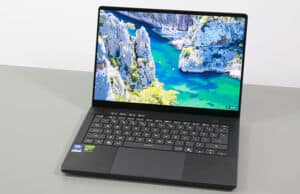
16-inch modern OLED display, non-touch The display on this Legion 7a is a 16-inch 16:10 OLED in a non-touch glossy implementation.
This is a recent-gen Samsung OLED panel, with 500 nits of sustained brightness and up to 1000 nits peak HDR brightness. That aside, contrast and blacks are the standards expected from OLEDs, and the fast refresh rate of 240Hz and quick response times of under 1ms make this a solid choice for watching movies and playing games.
The fact that this is non-touch is important, as texts and light colors look clean and smooth, unlike on most touch variants. At the same time, there’s no protective glass over the panel, like on touchscreens, but the finish is still reflective.
Here’s what we got in our tests, with an X-Rite i1 Display Pro sensor :
Panel HardwareID: Samsung SDC421B (ATNA60HU02-0);
Coverage: 100% sRGB, 94.6% Adobe RGB, 100% DCI-P3;
Type: 2.5K 2560 x 1600 px, 10-bit, 240Hz;
Measured gamma: 2.15;
Max brightness in the middle of the screen: 497.24 cd/m2 on power;
Min brightness in the middle of the screen: <10 cd/m2 on power;
Contrast at max brightness: 1:1;
White point: 6380 K;
Black on max brightness: 0 cd/m2;
PWM: Yes, to be discussed.
Overall, this is a solid modern OLED. Just keep in mind that it’s still a reflective finish, and it suffers from the standard OLED flickering that comes with the technology, at brightness levels other than 100%. However, this panel flickers at a high frequency of around 1.5 GHz; thus, this detail it shouldn’t concern most of you.
Hardware and performance Our test model is a mid-specced configuration of the 2026 Lenovo Legion 7a gen11, code name 16AGP11, with an AMD Ryzen AI 9 HX 470 processor, an Nvidia GeForce RTX 5060 8GB dGPU, 32 GB of LPDDR5x-8533 memory, and 1 TB of fast SSD storage.
Disclaimer: This is a retail unit provided by Lenovo for this review. It was tested on the software available as of mid-August 2026 (BIOS TPCN27WW, Legion Space 1.10.11.6, Nvidia Studio Driver 610.88). This is mature software, so little can change with later software updates.
Spec-wise, the 2026 Legion 7a is built on the latest AMD and Nvidia mobile hardware available to date.
The Ryzen AI 9 HX 470 is the highest-tier AMD Gorgon Point SKU for this year. It’s a hybrid design with 4x Zen5 Performance and 8x Zen5c Efficiency Cores, and runs at 80-90W of sustained power in this chassis, which is enough to ensure you’re getting the best this platform is capable of.
At the same time, Gorgon Point is only a minimal refresh of the existing Strix Point platform, thus more or less 2024 AMD tech rebadged under a new name. It’s still a fair performer for this more portable lightweight format, but its efficiency is not competitive against the Intel Panther Lake options of this generation. That means higher thermals under load and shorter battery runtimes, as you’ll see in a bit.
For the GPU, this 2026 Legion 7a series is only offered with a mid-powered mid-range Nvidia Blackwell GeForce RTX 5060 8GB (115W). The design includes a MUX and either regular Optimus or Advanced Optimus.
Lenovo’s spec sheet mentions an RTX 5070 12GB GPU option available for this series as well, but I’m not seeing that in stores anywhere at the time of this review.
The series comes with onboard LPDDR5x memory, either 32 or 64 GB. Our unit is the 32 GB variant, which is what you’ll mostly find in stores anyway.
For storage, there are two M.2 SSD slots, both gen4. One supports smaller 2242 drives on a PCIe 4.0 x4 connection, while the other supports full-size 2280 SSDs, but only on an x2 connection. Our unit bundles a fast 1 TB SSD, from a proprietary brand called UMIS.
The SSDs and the WiFi module are M.2 formats, upgradable. To get inside, you need to remove the back panel, held in place by a handful of screws. They’re of different sizes, so make sure you put them back the right way. Inside, you’ll notice the small main SSD format and the pretty measly speakers, with plenty of unused space around them. There’s also unused space at the front, around the battery.
This laptop bundles Lenovo’s updated Legion Space control software, offered with Legions since 2025. It’s still not the most intuitive piece of software, but it gets things done once you figure it out. The available power profiles are standard for a Legion: Quiet, Balance, Performance, and Custom, with the latter offering various settings for the CPU/GPU and fan control.
Anyway, here are the power limits and targeted fan noise levels for each of the default profiles:
Quiet Balance Performance Custom
CPU only, PL1/PL2 TDP
45/50W
65/80W
85/90W
90/95W
GPU only, max TGP
60W, D-Notify
75W
95W
115W
Crossload power,
75W, 15 + 60 W
105W, 30 + 75 W
125W, 30 + 95 W
150W, 35 + 115 W
Noise at head level, tested
<35 dBA
~38 dBA
~45 dBA
~52 dBA, max fans
These are standard settings for recent Legions, and they’re all fairly versatile for a device of this format. Balance mode is perhaps a bit aggressive on the settings and noise floor for a mid-level profile.
Before we jump to the performance section, here’s how this laptop handles everyday use and multitasking on the Quiet profiles, unplugged.
Performance and benchmarks – AMD Ryzen AI 9 HX 470 + Nvidia GeForce RTX 5060 On to more demanding loads, we start by testing the CPU’s performance by running the Cinebench R15 test for 15+ times in a loop. For consistency with other reviews, we keep the laptop raised on a stand.
Here’s what we got:
Performance mode – scores of 3200 points, 45-46 dBA fan noise, 85-90W sustained TDP, power limited at 100 °C;
Performance mode with the laptop flat on the desk – slightly lower scores as the TDP is thermally limited to around 80 W;
Balance mode – similar scores of 3200 points, 38 dBA fan noise, 80W TDP, internal temperatures around 95 °C (no thermal throttling);
Quiet mode – scores of 2850 points, ,30 dbA fan noise, 45W TDP, internal temperatures around 65-70 °C;
Balance mode on PD – scores of 2950 points, 35 dBA fan noise, 50W TDP, internal temperatures around 65 °C;
Balance mode on battery power – scores of 2800 points, <30 dbA fan noise, 45W TDP, internal temperatures around 65-70 °C.
The differences in performance are limited, within only 15% between all these modes. This AMD Ryzen AI 9 platform already delivers 90% of its potential at 50-60W TDPs. Above that, the CPU heats up a fair bit, and at 80+ W runs at over 90 °C in this chassis.
To put these findings in perspective, here’s how this AMD Ryzen AI 9 HX 470 implementation fares in this test against other mobile platforms offered in similar devices.
This performs mostly similarly to the previous-gen Ryzen AI 9 HX 370 platform, which was to be expected, since the 470 is merely a minor refresh of the 370. It also scores about on par with the Panther Lake Core Ultra 9 386H, which is what most 2026 rival models are built on – but that platform has its advantage in efficiency, as we’ll discuss further down. Nonetheless, both require serious cooling at higher power levels over 75W TDP.
Furthermore, this Ryzen 9 470 ends up about 20% faster than the mainstream Ryzen AI 7 450 platform offered on the entry-tier configurations of this Legion 7a, as well as other mid-tier products such as the Legion 5a.
At the same time, the Intel Core HX hardware in the Legion 7i and the full-size Legion Pro notebooks is still 50% faster in this sort of CPU multi-threaded load. So if you need a powerful CPU for sustained loads, get that one instead.
We then went ahead and further verified our findings with the more taxing Cinebench R23 loop test and Blender – Classroom, which resulted in slightly lower sustained power levels: almost 90W+ sustained for Custom with max fans, thermally limited, 85W sustained on Performance, 65W sustained on Balance, and 45W sustained on Quiet.
We also ran the 3DMark CPU test on the Performance and Quiet profiles.
Finally, we ran our combined CPU+GPU stress tests on this notebook. 3DMark stress runs the same test for 20 times in a loop and looks for performance variation and degradation over time. This unit fails the test both when kept flat on the desk and, surprisingly, when raised up on a stand, which means the performance is somewhat impacted when the heat builds up inside the chassis. More on that in the gaming section down below.
Next, we ran the entire suite of tests and benchmarks on the Performance profile with the GPU set on Hybrid mode and running on Nvidia Studio Drivers, and with the screen set at the native 2560 x 1600 px resolution. The laptop is placed on a stand for the best cooling performance and consistency with other reviews.
Here’s what we got:
3DMark 13 – CPU profile: max – 10755, 16 – 10109, 8 – 7317, 4 – 4537, 2 – 2352, 1– 1189;3DMark 13 – Fire Strike: 27383 (Graphics – 31076, Physics – 31587, Combined – 11922);3DMark 13 – Port Royal: 7307;3DMark 13 – Speed Way: 2795;3DMark 13 – Steel Nomad: 2605;3DMark 13 – Time Spy: 11188 (Graphics – 11499, CPU – 9705);3DMark 13 – DLSS: DLSS Off – 15.51 fps, DLSS On – 64.91 fps, 418% performance difference.
Uniengine Superposition – 1080p Extreme: 6518;Uniengine Superposition – 1080p Medium: 19403;
Aida64 Extreme, memory test – ;PCMark 10: 9205 (Essentials – 10699, Productivity – 16020, Digital Content Creation – 12349);GeekBench 6.6.0: Multi-core: 15671, Single-Core: 2952;GeekBench AI 1.7.0 (ONNX, CPU): Single: 3744, Half: 1833, Quantized: 7432;CineBench R15 (best run): CPU 3450 cb, CPU Single Core 317 cb;CineBench R23: CPU 24113 pts (best run), CPU 23974 pts (10 min loop test), CPU Single Core 2059 pts (best run);CineBench 2024: CPU 1237 (10 min run), CPU Single Core 119 pts;CineBench 2026: GPU – – pts, CPU Multiple Threads – 5031 pts, CPU Single Core – 644 pts, CPU Single Thread – 482 pts.
And some work-related tests, on the same Performance profile.
Blender 5.1.2 – BMW Car scene- CPU Compute: 1m 39s ;Blender 5.1.2 – BMW scene – GPU Compute: 20.84s (CUDA), 9.13 (Optix);Blender 5.1.2 – Classroom scene – CPU Compute: 3m 45s;Blender 5.1.2 – BMW scene – GPU Compute: 43.26s (CUDA), 20.21 (Optix);
SPECviewperf 2020 – 3DSMax 07: 106.98;SPECviewperf 2020 – Catia 06: 70.63;SPECviewperf 2020 – Creo 03: 108.67;SPECviewperf 2020 – Energy: 38.50;SPECviewperf 2020 – Maya 06: 406.04;SPECviewperf 2020 – Medical 03: 37.65;SPECviewperf 2020 – SNX 04: 23.81;SPECviewperf 2020 – SW 07: 256.60.
SPECviewperf 15 – 3DSMax 08: 31.10;SPECviewperf 15 – Blender 01: 54.18;SPECviewperf 15 – Catia 07: 45.46;SPECviewperf 15 – Creo 04: -;SPECviewperf 15 – Energy 04: 38.35;SPECviewperf 15 – Enscape 01: 37.26;SPECviewperf 15 – Maya 07: -;SPECviewperf 15 – Medical 04: 37.58;SPECviewperf 15 – Solidworks 08: 21.85;SPECviewperf 15 – Unreal Engine 01: 69.66;V-Ray Benchmark: CPU – 14790, CUDA – 1592, RTX – 2476.
Overall, this is a competitive mid-tier performer.
On the CPU end, this Ryzen 9 Gorgon Point hardware trails the Intel Panther Lake options by about 5% in IPC and single-core performance, but outmatches them in sustained multi-threaded loads by about 10%. That’s also partly because the CPU runs at a higher sustained TDP here than the Intel part does in most rivals (85-90W for the AMD hardware here vs. 70-75W in the Intel models). At around 70W, the platforms would perform neck and neck.
At the same time, this Ryzen hardware doesn’t outperform previous-gen AMD or Intel specs in any major way. So you’re getting similar overall capabilities to 2024-2025 platforms.
As for the Intel Core HX platform that powers the Lenovo Legion 7i series, that’s 50% faster in CPU multi-threaded chores, so definitely the better option for this sort of demanding activities. But that hardware doesn’t run as efficiently on battery power.
Finally, we need to discuss the AMD Ryzen AI 7 450 CPU option that’s also offered on this series, for about 100-200 USD/EUR less than the 470. That comes with 4x Zen5 and 4x Zen5c cores, while the 470 gets four extra Zen5c cores. For general use and multitasking, there’s hardly any noticeable difference between the two, while in sustained CPU loads, sure, the 470 ends up performing about 20% faster. If that’s important to you, then sure, get the 470 configuration; for most buyers, though, the 450 variant is going to be plenty enough.
On the GPU side, this series is only offered with a mid-tier RTX 5060 GPU, which is a fine performer overall for multitasking, most workloads, and even most games (with DLSS and FG). However, this GPU can be limiting for some of you, especially since it comes with only 8 GB of vRAM. As a result, the slightly lower-power RTX 5070 12GB chip offered in the Yoga Pro 7i/9i 2026 models is a more versatile offer overall.
Furthermore, the 5070Tis bundled with competing options from other brands are 25-40% more capable, while the RTX 5080 configurations are 50-70% faster.
Custom Mode – max power, 52+ dBA noise Custom mode allows for a multitude of CPU/GPU power customizations and fan settings.
I maxed out the CPU and GPU settings, set the fans to their max RPMs, and placed the laptop on a stand to improve airflow into the fans and underneath the chassis. At max, the fan noise reaches 52 dBA at head level, much louder than in Performance mode.
Here’s what we got.
3DMark 13 –CPU profile: max – 10389, 16 – 9450, 8 – 7090, 4 – 4535, 2 – 2361, 1 – 1197;3DMark 13 – Fire Strike: 26939 (Graphics – 31474, Physics – 31081, Combined – 11813);3DMark 13 – Time Spy: 11444 (Graphics – 11659, CPU – 10364);Uniengine Superposition – 1080p Extreme: 6516;CineBench R23 (10 min loop): CPU 23848 cb, CPU Single Core 2064 cb;Blender 5.1.2 – Classroom scene – CPU Compute: 3m 43s.
These results are on par with Performance mode, as the CPU and GPU already run at sufficient power levels on that profile. These settings don’t make any sense here.
Balance Mode – low power, 38 dBA noise Balance mode is the mid-level profile that keeps fan noise low at only ~38 dBA, with a slight impact on power levels and general performance.
Here’s what we got in this case:
3DMark 13 – CPU profile: max – 10290, 16 – 9381, 8 – 6990, 4 – 4508, 2 – 2303, 1 – 1187;3DMark 13 – Fire Strike: 24856 (Graphics – 27979, Physics – 30664, Combined – 11719);3DMark 13 – Time Spy: 10106 (Graphics – 10053, CPU – 10418);Uniengine Superposition – 1080p Extreme: 5470;CineBench R23 (10 min loop): CPU 22567 cb, CPU Single Core 2060 cb;Blender 5.1.2 – Classroom scene – CPU Compute: 3m 48s.SPECviewperf 2020 – 3DSMax: 100.90;SPECviewperf 2020 – Catia: 66.36;SPECviewperf 2020 – Maya: 388.10;SPECviewperf 2020 – SNX: 23.09;SPECviewperf 2020 – SW: 240.13.
On the CPU side, we’re still looking at about 95-98% of what’s possible in Performance mode, even in Blender. On the GPU side, the 5060 capped at 75W still scores about 85-90% of Performance mode.
Furthermore, despite the much quieter fan noise, thermals are lower overall in this mode, generally in the mid-70s °C. So a highly competitive mid-level profile overall, even though I still think Lenovo could push the noise floor towards 40 dBA for even slightly better thermals.
Quiet Mode – lower power, sub 35 dBA noise Quiet mode limits the CPU/GPU power even more to keep noise levels at sub-30 dBA and temperatures still in check.
Here’s what we got:
3DMark 13 – CPU profile: max – 9074, 16 – 7552, 8 – 4536, 4 – 2675, 2 – 1480, 1 – 787;3DMark 13 – Fire Strike: 21554 (Graphics – 24753, Physics – 26034, Combined – 9678);3DMark 13 – Time Spy: 8830 (Graphics – 8730, CPU – 9449);Uniengine Superposition – 1080p Extreme: 4911;CineBench R23 (10 min loop): CPU 19125 cb, CPU Single Core 1352 cb;Blender 5.1.2 – Classroom scene – CPU Compute: 4m 15s.
The CPU performs at about 80-85% of its max capacity in multi-threaded loads, but only at about 60% in single-core IPC, which is rather weird; the GPU runs at about 75% of what it can do in Performance mode – overall fair results for this sort of profile. Thermals are even better than in Balance mode, in the low to mid-60s °C.
Balance Mode on PD power I tested this laptop on USB-C power delivery with a 100W ROG PD charger. I don’t have a Legion PD charger to test if that would change things in any way.
Here’s what we got in terms of benchmark results on Balance mode on USB-C PD power:
3DMark 13 – CPU profile: max – 8764, 16 – 8370, 8 – 6438, 4 – 4195, 2 – 2257, 1 – 1170;3DMark 13 – Fire Strike: 19396 (Graphics – 20783, Physics – 28235, Combined – 9846);3DMark 13 – Time Spy: 7550 (Graphics – 7293, CPU – 9438);Uniengine Superposition – 1080p Extreme: 4115;CineBench R23 (10 min loop): CPU 20466 cb, CPU Single Core 2036 cb;Blender 5.1.2 – Classroom scene – CPU Compute: 4m 01s.SPECviewperf 2020 – 3DSMax: 77.24;SPECviewperf 2020 – Catia: 51.35;SPECviewperf 2020 – Maya: 305.84;SPECviewperf 2020 – SNX: 22.93;SPECviewperf 2020 – SW: 177.68.
Decent results on the CPU, but rather limited on the GPU, lower than on Quiet with the main charger plugged in – I wouldn’t necessarily use the laptop on PD charging for any sustained loads more than occasionally, especially as it seems to pull energy out of the battery as well, and that can affect the battery long-term.
For general use and multitasking, though, this use case makes perfect sense, especially if you don’t want to lug around the bulky main charger for your commutes or travels.
Gaming performance – Gorgon Point Ryzen AI 9 + GeForce RTX 5060 With benchmarks out of the way, let’s see how this Legion 7a handles modern games.
We tested a couple of different games on the various available profiles at the native QHD+ (2560 x 1600 px) resolution, with the Nvidia GPU set on dGPU mode and running on Nvidia Studio drivers. For consistency with other reviews, the laptop is raised off the desk.
Here are the results:
Lenovo Legion 7a, RTX 5060 Laptop 100-115W QHD+ Performance, QHD+ Custom, QHD+ Balance, QHD+ Quiet,
Black Myth: Wukong 36 fps (22 fps – 1% low)
–
–
–
Black Myth: Wukong 46 fps (32 fps – 1% low)
47 fps (34 fps – 1% low)
40 fps (26 fps – 1% low)
32 fps (22 fps – 1% low)
Black Myth: WukongMFG On 4x 83 fps (20 fps – 1% low)
85 fps (20 fps – 1% low)
74 fps (16 fps – 1% low)
58 fps (10 fps – 1% low)
Cyberpunk 2077 42 fps (24 fps – 1% low)
–
–
–
Cyberpunk 2077MFG On 2x , Ray Reconstruction On, 58 fps (26 fps – 1% low)
60 fps (26 fps – 1% low)
53 fps (22 fps – 1% low)
46 fps (16 fps – 1% low)
Cyberpunk 2077MFG On 4x , Ray Reconstruction On, 100 fps (22 fps – 1% low)
102 fps (22 fps – 1% low)
90 fps (20 fps – 1% low)
78 fps (16 fps – 1% low)
Horizon Forbidden West 78 fps (582 fps – 1% low)
82 fps (60 fps – 1% low)
80 fps (49 fps – 1% low)
52 fps (38 fps – 1% low)
Horizon Forbidden West 95 fps (75 fps – 1% low)
98 fps (76 fps – 1% low)
86 fps (68 fps – 1% low)
65 fps (46 fps – 1% low)
Red Dead Redemption 2 81 fps (58 fps – 1% low)
83 fps (59 fps – 1% low)
74 fps (52 fps – 1% low)
60 fps (46 fps – 1% low)
Shadow of Tomb Raider 96 fps (74 fps – 1% low)
100 fps (76 fps – 1% low)
84 fps (66 fps – 1% low)
68 fps (52 fps – 1% low)
Black Myth, Cyberpunk, Horizon FW – recorded with MSI Afterburner fps counter in campaign mode;
Far Cry 6, Red Dead Redemption 2, Tomb Raider – recorded with the included Benchmark utilities;
Red Dead Redemption 2 Optimized profile based on these settings .
Fair results overall, with most games playable even at 2.5K resolution and Ultra settings. DLSS with FG makes a big difference where available, of course.
Just keep in mind that the RTX 5060 only comes with 8 GB of vRAM, and that can be a limiting factor in some recent AAA titles. If your framerates are far worse than expected, make sure the settings are not exceeding the memory limits, and drop the graphics details until the experience becomes consistent.
For what it’s worth, the Core Ultra 7 275HX + RTX 5070 115W configuration of the Legion 7i outscores this model by about 10-15% in the tested games, while the Core Ultra 9 386H + RTX 5060 100W configuration in the Lenovo Yoga Pro 7i scored 10-20% lower somehow (that doesn’t include a MUX). At the same time, the Core Ultra 9 386H + RTX 5070Ti configuration in the ROG Zephyrus G14 delivers 25-30% higher frame rates on average.
With that out of the way, let’s go through some CPU/GPU logs.
First, here’s the laptop on Performance mode, raised off the desk.
We measured internal CPU/GPU temperatures in the mid to high-70s °C, with fan noise levels of 45 dBA at head-level. The GPU generally runs at around 95W TGP between the tested titles, a little lower than expected or than tested on the Legion 5a model (which averages 105W TGP for this profile).
Keeping the laptop flat on the desk doesn’t change the performance in any notable way, but it does lead to the hardware and chassis running hotter. We measured closer to 78-80 °C on the CPU/GPU in this use case, so I’d keep the laptop raised off or on a stand as much as possible.
As for the Custom mode, this allows for higher GPU TGP at closer to 110-115W, with fan noise levels of 52 dBA at max. Thermals are still measured in the mid to high 70s °C with these settings, and the overall frame rates are only marginally higher than on Performance mode, within 5-7%. Not a mode I’d use here.
Balance and Quiet modes, on the other hand, are very interesting options.
Balance mode keeps fan noise under 38 dBA with CPU/GPU temperatures in the lower to mid 70s °C, while the delivered frame rates are still fine, at about 80-90% of Performance mode.
Quiet mode keeps the noise floor under 30 dBA, with even lower CPU/GPU temperatures in the 60s °C, with frame rates at about 70% of Performance mode.
I’d consider both these modes for playing casual games on this Legion 7a, even over the noisier Performance profile.
Noise, Heat, Connectivity, speakers, and others The cooling module on this Legion 7a is rather simple, with two fans, two average-sized heatsinks, and three heat pipes.
For comparison, the cooling in the Legion 7i is somewhat beefier, with larger heatsinks and thicker fans; that’s because the 7i is a larger and thicker chassis and needs to cope with a more power-hungry Intel Core HX platform.
This module works fine and allows for solid performance out of this AMD platform, with fair internal temperatures in mixed use, as long as you keep this laptop raised off the desk with sustained taxing loads. We’re generally looking at internal temperatures in the mid-70s °C for sustained mixed use. Flat on the desk, the fan intake gets choked, and the internal temperatures rise by about 5 °C.
I’ll also mention that sustained CPU loads where more than 80W of TDP power is pushed into the CPU can be a limiting scenario here, causing the AMD hardware to run hot and even throttle around the 100 °C mark. However, if you’re looking for a laptop that delivers solid performance in this sort of scenario, perhaps a Ryzen AI 9 shouldn’t be the one to get anyway.
As far as the noise levels go, expect 52 dBA on Custom mode, 45 dBA on Performance, 38 dBA on Auto, and sub-30 dBA on Quiet.
With daily use, the fans rarely idle, regardless of power profile or whether the laptop is plugged in or unplugged. They do shut off eventually with light use on battery power. At the same time, these fans spin slowly and inaudibly in a normal environment, and there are no annoying speed fluctuations with multitasking. I also haven’t noticed coil whine or other sorts of electronic noises on my unit. Overall, the fans are unnoticeable, unless you keep the laptop in a perfectly quiet room.
External temperatures are excellent overall, with most surfaces keeping under 30 °C.
*Daily Use – streaming Netflix in EDGE for 30 minutes, Quiet Mode, fans at <30 dB
With demanding loads, most of the chassis still stays comfortable when using the laptop in Performance mode and raised off the desk, with the middle of the keyboard hitting low-40s °C, while the sides and armrest average in the mid-30s °C. A much warmer hotspot develops at the top of the keyboard, though, just next to the power button.
Keeping the laptop flat on the desk leads to somewhat higher thermals, by a few degrees.
As for the other profiles, both Balance and Quiet mode run slightly cooler all over the chassis.
Overall, these are fair thermals for a thinner design with this sort of hardware, even with the hotspot at the top and bottom.
*Gaming – Balance mode – playing Cyberpunk for 30 minutes, fans at ~38 dB
For connectivity, there’s the latest-gen Wi-Fi 7 and Bluetooth 5.4 through a Realtek module on this laptop. Everything performed fine in my time with this laptop.
Audio is suposedly handled by a set of four speakers; the specs mention separate woofers and tweeters, but I’m only seeing a pair of rather small speakers inside (they’re perhaps dual-sided speakers). The sound comes out through the bottom, and while these can get averagely loud at about 80 dBA, the quality is mediocre, with limited bass. Audio quality is the most noticeable weakness of this series. Overall, these speakers are a little louder than on the Legion 7i model, but the sound is mostly similar and subpar for a multimedia laptop in 2026.
Finally, there’s a 5MPx camera placed at the top of the screen, flanked by microphones. It’s the same one implemented in other Legions and Yogas, a wide-angle camera that provides fine images in good light, and decent images in dimmer conditions. Comes with a camera kill-switch on the laptop’s right edge, and offers IR with support for Windows Hello.
Battery life There’s an 84 Wh battery inside this Lenovo Legion 7a, which is a little smaller than what the competition offers in this space.
Here’s what we got in our battery life tests, with the screen’s brightness set at around 120 nits (~50% brightness) and the default 60Hz refresh rate (switches to 60Hz automatically when unplugged). I’ve also set the Windows 11 power mode to Best Power Efficiency.
7 W (~12 h of use) – idle, Quiet Mode, screen at 0%, Wi-Fi ON;10-12 W (~6-8 h of use) – text editing in Google Drive, Quiet Mode, screen at 50%, Wi-Fi ON;9 W (~9-10 h of use) – 1080p fullscreen video on Youtube in Edge, Quiet Mode, screen at 50%, Wi-Fi ON;9 W (~9-10 h of use) – Netflix fullscreen in Edge, Quiet Mode, screen at 50%, Wi-Fi ON;12-20 W (~4-7 h of use) – browsing in Edge, Quiet Mode, screen at 50%, Wi-Fi ON;90 W (<1 h of use) – Gaming – Cyberpunk, Balance Mode, screen at 50%, Wi-Fi ON.
Decent runtimes all things considered, although this is the least efficient platform of this generation, in the higher-performance mobile space. Furthermore, anything related to the browser was quite heavy on efficiency here, with serious variations in power draw between tabs and apps, even with light use such as editing texts in Google Drive. That means mileage with general use can vary greatly, from only 4 hours and up to 8 hours on a charge.
For comparison, here’s what we got on the Legion 7i on the Intel Arrow Lake Core HX platform.
15-18 W (~5-6 h of use) – text editing in Google Drive, Quiet Mode, screen at 50%, Wi-Fi ON;18-20 W (~4-5 h of use) – 1080p fullscreen video on Youtube in Edge, Quiet Mode, screen at 50%, Wi-Fi ON;14-16 W (~5-6 h of use) – 4K Netflix with Dolby Vision, fullscreen in Edge, Quiet Mode, screen at 50%, Wi-Fi ON;18-22 W (~4-5 h of use) – browsing in Edge, Balance Mode, screen at 50%, Wi-Fi ON.
Shorter runtimes across the board, and especially with video streaming.
At the same time, here’s the Yoga 9i Pro on the Panther Lake platform and with the Tandem OLED display; this runs significantly more efficiently.
8-10 W (~9-10 h of use) – text editing in Google Drive, Battery Saver Mode, screen at 40%, Wi-Fi ON;7-7.5 W (~12-13 h of use) – 1080p fullscreen video on Youtube in Edge, Battery Saver Mode, screen at 40%, Wi-Fi ON;6.5-7 W (~13-14 h of use) – Netflix fullscreen in Edge, Battery Saver Mode, screen at 40%, Wi-Fi ON;10-12 W (~8-9 h of use) – browsing in Edge, Adaptive Mode, screen at 40%, Wi-Fi ON.
This series ships with a 245W charger, a pretty bulky charger for a laptop of this kind.
USB-C charging is supported as well, and is an option worth considering for regular use and multitasking, but not for heavier workloads or games.
Price and availability – Lenovo Legion 7a series At the time of this article, the Lenovo Legion 7a series is widely available in most markets. You’ll mostly find it in the White variant, though the Nebula dark-blue color is available as well in some markets, especially directly on Lenovo’s own websites.
Follow this link for updated prices and configurations in your area .
The exact model tested here, the Legion 7a with the AMD Ryzen AI 9 HX 470 processor, 32 GB of RAM, 1 TB SSD, and the RTX 5060 GPU specs, goes for 2399 USD in the US, 2200-2350 EUR in Europe, and 2200 GBP in the UK. These are fairly competitive prices in all markets for 2026 standards, and don’t account for any occasional sales or discounts that can shave a few hundred off the retail price.
At the same time, a configuration built on the AMD Ryzen AI 7 450 processor is available as well, generally for 100-200 USD/EUR/GBP less. That’s a fine option for general use and multitasking, and generally the one I’d recommend for most buyers anyway. It is ~20% slower under sustained loads than the Ryzen 9 470, but I don’t expect you’re buying this Legion 7a for its sustained CPU performance capabilities anyway. No other important variations are offered, so no higher-tier GPU options of any kind.
Follow this link for updated prices and configurations in your area , at the time you’re reading this article.
Final thoughts- 2026 Lenovo Legion 7a review This Lenovo Legion 7a is overall a competitive lightweight all-purpose laptop. It’s built well, functional and ergonomic, offers proper inputs and IO, and a beautiful modern-gen OLED display.
Internally, it’s built on an AMD Ryzen platform with mid-range Nvidia RTX graphics, alongside fast memory and a fast SSD, and these specs will suffice for most general use, serious multitasking, as well as most work/school/gaming requirements. Of course, there are faster options out there, both for the CPU and especially for graphics capabilities, but those are generally larger and heavier formats, and surely much more expensive.
In fact, this Legion 7a is more affordable than pretty much any 2026-generation alternative, as you’ll see in a bit. But first, I must touch on the three potential issues that you’ll have to accept with this series: it mostly comes in the white variant in most regions, the speakers provide poor sound quality, and the efficiency on battery power offered by this AMD platform is not on par with the devices built on Intel Panther Lake hardware.
At the same time, though, most of the competing Panther Lake options are higher-tier and higher-priced options bundled with more powerful 5070Ti/5080/5090 GPUs, starting at well over 3K USD/EUR. And even those few 5060 models are generally more expensive than this Legion, such as the Yoga Pro 9i or the Pro 7i we’ve tested recently.
From what I’m seeing, the only somewhat similar option you could consider instead is the base-level Razer Blade 16 , but even that is more expensive than this Legion outside of the US, and only comes with a Ryzen AI 9 365 CPU. And then there’s the even more affordable Lenovo Legion 5a model , as well, but that’s not quite as compact or lightweight or premium-feeling. We’ll have a separate article comparing the Legion 7a and 5a options in due time. Finally, the Lenovo Yoga Pro 7i is another potential alternative, a more standard design in a more compact premium chassis, more efficient than the Legions, but at the same time not quite as capable in graphics loads due to implementing a lower-powered RTX chip.
So all in all, this Lenovo Legion 7a is arguably the most competitive device of its kind, a premium lightweight 16-inch jack-of-all-trades laptop for the average user. Too bad Lenovo didn’t put more effort into better audio here; there’s plenty of room inside that chassis for more capable speakers, and it would have made a notable difference on this sort of device.
Anyway, this wraps up my time with the Lenovo Legion 7a. Looking for your questions, thougths and feedback in the comments section below.
Disclaimer: Our content is reader-supported. If you buy through some of the links on our site, we may earn a commission.
Terms .
Navigation: Ultrabookreview.com » Lenovo
Review by: Andrei Girbea
Andrei Girbea is a Writer and Editor-in-Chief here at Ultrabookreview.com . I write about mobile technology, laptops and computers in general. I've been doing it for more than 15 years now. I'm a techie with a Bachelor's in Computer Engineering. I mostly write reviews and thorough guides here on the site, with some occasional columns and first-impression articles.



NikoB
August 27, 2026 at 2:16 pm
Andrei,
why did you call the (AM)OLED screen "beautiful" if it doesn't meet that definition at all?
It's 100% unsafe for the eyes, even by the international standard for minimum PWM frequency (1.25 kHz), as is evident in other reviews of this model (and laptops with (AM)OLED panels in general). It can't display FHD or 4K video properly (without blurring), as it's natively 2.5K (which is extremely poor in any case, even in terms of text quality). It doesn't reach 95%+ AdobeRGB, meaning it's not suitable for high-quality color correction in photographs (only for HDR video, but even that's questionable, as I'll show below).
Its actual contrast is questionable, as… Lenovo doesn't officially guarantee even 1:1M, often only 1:100K in psref. 1:2M is required to at least meet Display True Black HDR (XXX) standards—and only screens that actually support this standard can realistically display HDR10 images.
Meanwhile, smartphones (at least Xiaomi) are already claiming PWM above 2kHz. I've seen these models in person, and they actually pass pencil tests even at minimum brightness, although the camera still shows some streaking. But this is significantly better than the infamous 60-480Hz (and previously 60-250Hz) typical for laptop and monitor panels today.
Moreover, as we know, monitor manufacturers are rushing to switch to StripeRGB matrices (an attempt to create an analogue to the typical subpixel structure of IPS matrices), but this laptop's matrix is precisely that old, poor subpixel structure, which has long been well-documented in blogs, making any text blurrier due to its shortcomings.
Therefore, this laptop's screen is in no way considered "perfect OLED." It's not compatible with FHD/4K video (the image is always blurry at the pixel level), has insufficient ppi for text (at least 220-230+, but 300+ is better), and is incredibly reflective because… Glossy displays, unlike semi-matte and matte displays (which have been off the market for over 10 years due to an obvious flaw in the surface etching of high-resolution panels), significantly increase eye fatigue in challenging lighting conditions. They have a significantly reduced burn-in lifespan, even with forced pixel shifting at high frequencies, which also negatively impacts vision and fatigue.
Currently, there are no "perfect" displays that meet all eye health requirements. Only IPS displays in laptop screens and monitors are safe for the eyes (and nervous system), and only 4K/8K IPS displays offer text and video quality. Meanwhile, 120Hz+ versions are available, along with 95%+ AdobeRGB displays.
The only limitation 4K IPS displays fail to meet is that they will never be able to provide high contrast (low black levels), meaning they will never be able to support the HDR10 standard. But is it really necessary in practice? In terms of color depth, IPS can easily deliver 30-36 bits, meaning banding-free images even with dynamic gradients on the screen.
So, last year, the industry began a premature and forced transition (although it will take at least another 4-5 years to perfect them) of laptop screens to eye-damaging AM (OLED) matrices, which are universally glossy. While this may be acceptable for "gaming" series and for such purposes, it's unacceptable for work-related tasks, such as working for 6+ hours in front of such laptops. Even "gaming" series are often used for extended periods outside of gaming. And forcing this onto work-related series is a terrible mistake by laptop manufacturers. Given current developments, consumers have effectively lost the power to pressure hardware manufacturers (they simply don't care about ordinary consumers; all their profit margins are in the corporate sector). This needs to be addressed regularly so readers understand the reality of what they're trying to sell them. Not everyone is so well-versed in the subject. And children shouldn't be allowed to use such screens at all until manufacturers at least bring the PWM frequency up to the level of Xiaomi smartphones from 2025. And Apple and Samsung, as trendsetters, don't care about this. Normal people don't spend hours in front of smartphones, but they easily spend many hours a day in front of laptop screens, and the larger the diagonal (certainly 15.6+), the more likely this is.
It's appalling that the hardware industry has completely forgotten about the safety and eye comfort of those who work long hours in front of screens. In terms of eye safety, we've essentially returned to the days of CRT screens, even though the screens are technically digital. Unless you're staring at an electron gun…
P.S. There's nothing to even comment on in terms of performance (it's pointless) – it's all bleak for 2026. And at a greatly inflated price, too…
Andrei Girbea
August 27, 2026 at 4:09 pm
Niko, this is a fine screen for most people. Flikr aside, which can be a concern to some extent, and even that's not that big of a deal at 1.5 GHz frequency, I doubt regular users would be bothered by the aspects that you're mentioning.
Sure, if you start nitpicking, your complaints are valid. But to expect perfection (in anything, not just this topic) is a waste of time.