
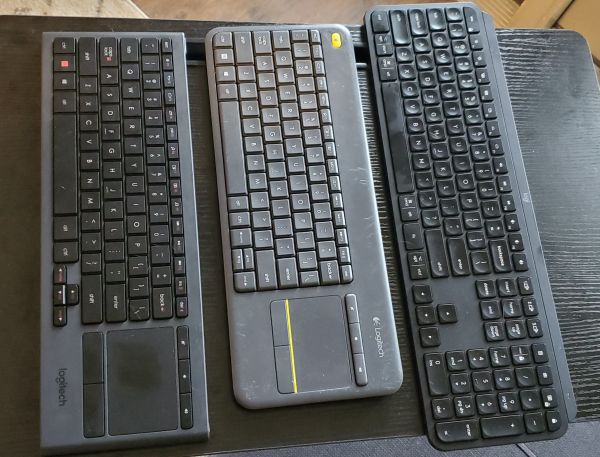
In this article, I’m sharing with you my experience in searching for the best wireless keyboard for my home theatre (HTPC) setup, comparing the different models that I’ve tried out, and explaining my current favourite and why.
There’s no denying how important a keyboard can be. They are one of the key (no pun intended) methods of interfacing with the computers we use for so much of our work and play. A bad or good keyboard can make or break one’s user experience accordingly, and so it’s best to put a bit of thought into the purchase of one.
5/18/26 update: Added review and comparison for Arteck Universal Backlit 7-Color Bluetooth Keyboard
There are a many choices to consider: mechanical or membrane, Cherry MX or Brown switches, chiclet or classic, wired or wireless, etc. While wired is still king for those who want minimum latency or downtime, there are a number of reasons to need a wireless keyboard:
- Frequently changing your working position at your workstation.
- Using the computer from a distance (e.g. a home theatre PC setup).
- Having pets for whom wires are a tasty snack.
Since I like to play from a living-room setup with a 55″ inch TV and am a proud rabbit-dad I’ve been a wireless keyboard and mouse fan for years now. I’ve tried a few different options for my setup over the years, and in this article I’d like to share my thoughts regarding the Logitech K400 Plus, K830, and MX Keys wireless keyboards, and my new favourite pick for HTPC keyboard: the Arteck Universal Backlit 7-Colors Bluetooth Keyboard.
The Keyboards
This article is limited to wireless keyboards I have spent quite a bit of time using, and thus it does not include keyboards I have not personally used.
There are a lot of brands out there, and while I used to use Logitech products pretty much exclusively, the company in general has lost my trust due to their reliance on bloated software and the mess they made of things with mixing up universal and bolt receivers and splitting them up, requiring different software to configure each. My previous favourite, the K400 Plus, also seems to have long-term reliability issues with connectivity and the touchpad staying functional. Having been through 4 or 5 of the K400 Plus keyboards over the last decade, I wanted to see if I could find something better, which is what led me to the Arteck backlit keyboard.
Also, please keep it in mind that while I play games, I’m not a competitive gamer, and I’m not concerned with getting the lowest ms response time. These aren’t super-fancy high-performance gaming/RGB keyboards, but their performance is generally enough to satisfy all but competitive gamers, I think.
-

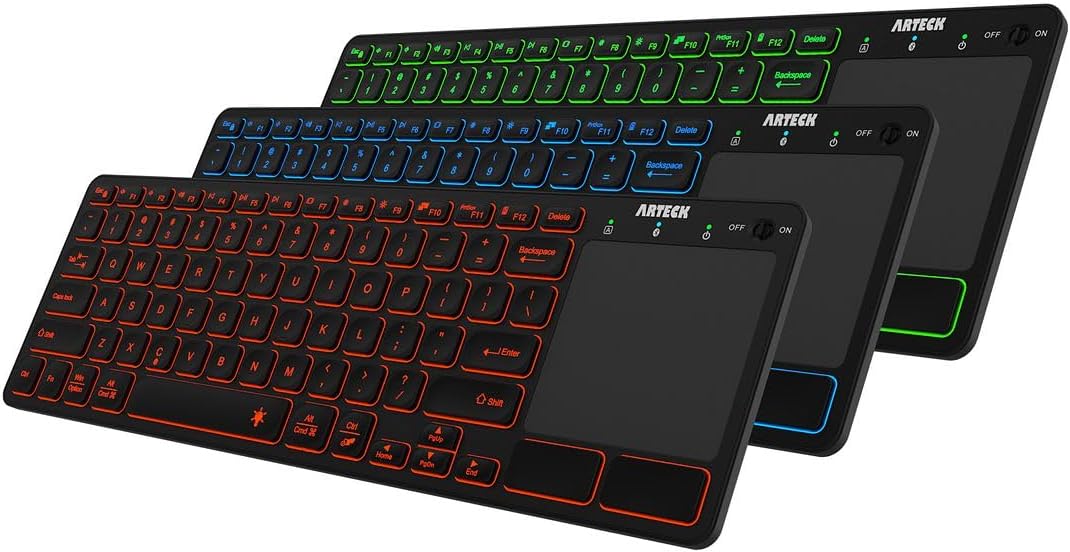
- The Arteck Universal Backlit Bluetooth Keyboard
-
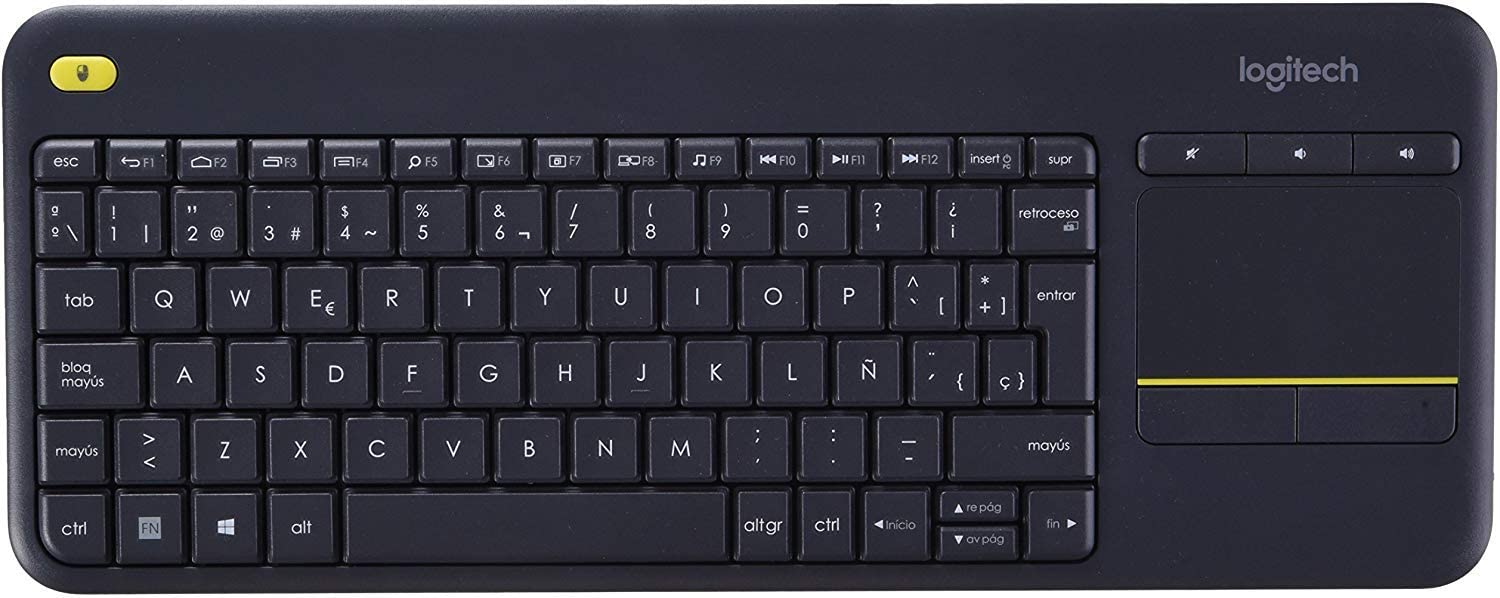
- The classic K400 Plus (non-backlit)
-
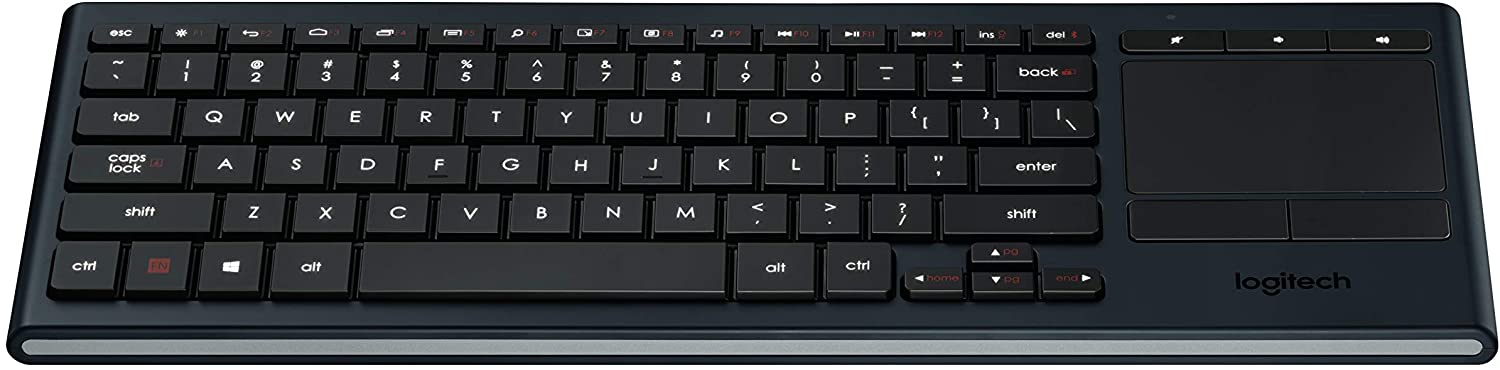
- The K830 (backlit)
-
- The Logitech MX Keys (backlit)
Arteck Universal Backlit 7-Colors Bluetooth Touch TV Keyboard
I stumbled upon this keyboard last year after I started experiencing regular connectivity and trackpad issues with my Logitech K400 Plus. The lack of a backlight was also an issue that bugged me fairly regularly, so I thought I would check Amazon to see if, in the decade-plus that the K400 Plus had been out, wireless keyboards with touchpads had made any major strides. I was surprised to find out that this market segment actually hadn’t progressed as much as I thought it might have. If you’re looking for a backlit keyboard that is wireless, has decent battery life, and has a trackpad, the pickings are actually pretty slim.
I spent a few days browsing and checking user reviews before deciding to try the Arteck. I hadn’t heard of the brand before, but the feature set made it look pretty promising. Having an integrated Li-ion battery is great, and in my experience, it lasts for several weeks on a charge (and that’s with the backlight enabled!).
When the keyboard arrived, my first impressions of it were very positive. The keyboard feels solid, similar to the MX Keys and significantly better than the K400 or K830. The other thing that was immediately apparent was that the feel of the keys and switches was far better than the other keyboards I had been using. It’s got a good amount of travel, more than 1.3mm, I would say, the switches are very stable and don’t wobble, and best of all, the keys have a well-designed concave curvature for your fingers to slip into. As far as typing experience goes, this keyboard gets a 9/10 from me.
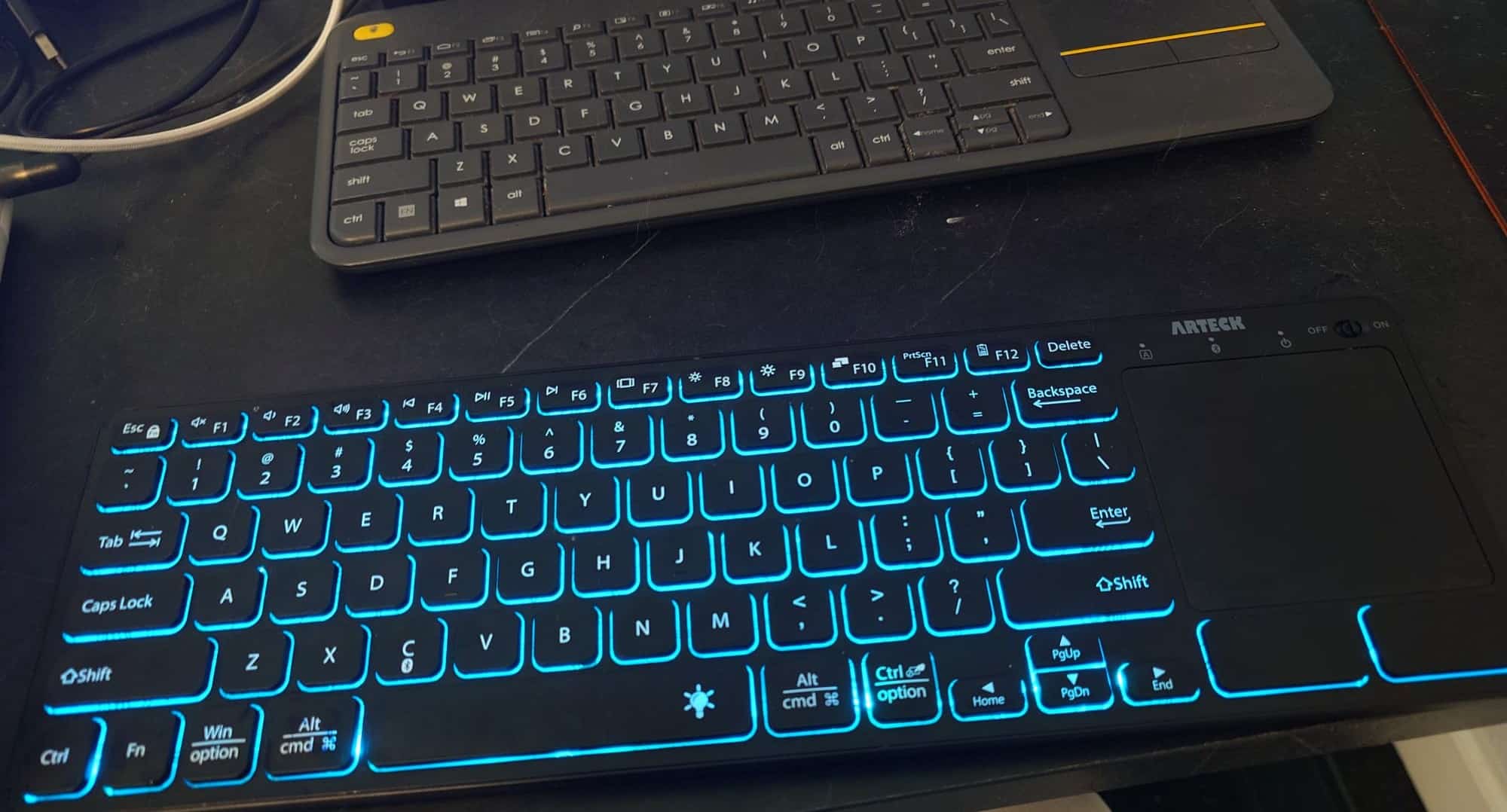
The Arteck 7-Color Bluetooth Keyboard next to the Logitech K400 Plus at my desk.
This is a Bluetooth-only keyboard, however; it has no 2.4Ghz receiver, which means if every millisecond counts for you in your key presses, it might not do it for you. That being said, it does more then well enough for playing Doom: Eternal on nightmare, so I think all but the most demanding gamers (who probably want wired anyway) will be happy with the latency.
The keyboard charges its internal battery through USB-C cable, and I would say it takes 2-3 hours to fully charge and will last for 2-3 weeks with the backlight enabled, and probably a lot longer if you don’t use the light. The light turns off when the keyboard is idle to preserve battery, but tapping a key or moving the mouse will wake it from its sleep state and reactivate it. I think this approach is a good way to balance responsiveness with battery life.
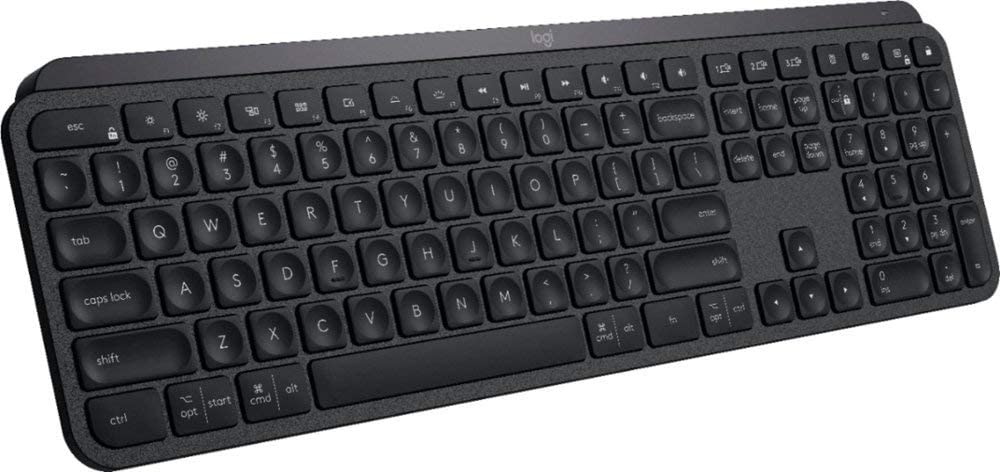
In terms of the keys and layout, unlike on the K400, you can toggle the function keys without using any software (in fact, there is none, which IMO is a positive), which gives you one-touch functionality for things like volume, media control, brightness, and so-on. I also appreciate that the Win and Alt keys double as option and cmd keys for Mac support.
The touchpad is a big part of HTPC keyboard functionality, and the Arteck doesn’t disappoint here. Its touchpad feels significantly better than the K400 or 830, with smooth and responsive action. My favourite feature of it, though, are the mouse keys. They use a similar switch to the keyboard keys, so they feel satisfying and smooth to press as opposed to the plastic “clicky” feel that most other touchpad clickers have. This is probably a somewhat subjective thing, however, as no doubt some people have a preference for the classic “click” feel that mouse buttons generally have had for the last few decades. That being said, I really like the feel of the buttons, and I welcome it as an improvement.
Lastly, the backlight feature is a fun bonus in that you can change between seven different colours: white, cyan, yellow, red, purple, green, and blue. You can toggle between the colors with Fn + Space + Up/Down arrow, and adjust the brightness with just Fn + Space. I personally like the cyan, but I’m sure there will be a colour that appeals to just about everyone.
I’ve been using this keyboard for about six months now, and feel that it’s been enough time for me to say that it’s passed my tests and I would recommend it to others, which is why I’m updating this article now.
I do feel that I should mention, however, that when I initially bought this keyboard last year, it had a firmware bug that would occasionally prevent key presses from being registered while the mouse was being clicked. I contacted Arteck and asked about the issue, and they told me it was a “feature” they were aware of and were working on a fix for. To their credit, they apologized and offered to send me a wireless mouse while also refunding me the price of the keyboard. I didn’t need the wireless mouse, but I accepted the refund (they wanted me to keep the keyboard). So, I went back to using my K400 for a couple of months, until I received an email from Arteck. They told me that they had fixed the issue and would be sending me a replacement keyboard, free of charge. A couple of weeks later, the keyboard arrived, and I was happy to find that it was working perfectly as expected, and I’ve been using it ever since.
I do expect that this issue should be fixed, but it would be remiss of me not to mention my experience with it when I first tried it about a year ago before they fixed the firmware.
One last thing that people might care about is that this keyboard doesn’t support multiple devices. If you want to connect it to a new device, you will need to press Fn + C to activate pairing mode, then connect to it from the device.
So, that’s pretty much everything I can think of about the Arteck Universal Backlit keyboard! Let’s go to the Pros and Cons:
Pros:
- USB-C charging w/ internal battery
- Long-lasting batteries (2-4 weeks easily)
- Fairly priced
- Very well-built
- Class-leading typing and touchpad experience
- Bluetooth 5.1
- Backlit with seven different colors!
- Mac key labels (and no co-pilot key!)
- T-shaped arrow keys
- No need for software to use all features
- 2-year warranty with excellent support (thus far)
Cons:
- No 2.4 Ghz receiver
- No multi-device support
Logitech K400 Plus
Debuting in 2015, the Logitech K400 Plus is not the newest keyboard around and even resembles a bit of a classic at this point. But, like all classics, it stays around for a good reason or two. In the K400’s case, it’s inexpensive, rugged, decent to type on, and has batteries (two AA batteries, unlike the internal Li-ion cells that power the K380 and MX Keys) that last for ages. If you’re looking for a non-nonsense, budget keyboard for your HTPC or even desktop, you can’t go wrong for the price — as long as you won’t always be typing in the dark.
Pros:
- Lasts forever on batteries (~1 year)
- Dedicated volume buttons
- Cheap
- Rugged
- Typing experience is decent
- Integrated touchpad with physical buttons
- Uses unifying receiver (2.4 GHz)
Cons:
- No backlight
- Requires AA batteries
- Touchpad gets finicky with any moisture
- No Bluetooth or multi-device support
Logitech K830
The only thing I didn’t like about my K400 Plus was the lack of backlight. Thus, when I found myself needing a wireless keyboard after a rough moving situation left me without my belongings for more than 30 days, I bought the K830 assuming it would be a straight upgrade. Despite the higher model number, however, it turns out that the K830 was released even before the K400 Plus was — in 2014! Thus, I actually found that the user experience was considerably worse for me on the backlit K830 than the K400 Plus.
Let’s start with the positives, though. The K830 has an internal li-ion battery, and it charges with a micro-USB B cable. It’s robustly constructed, and has a rather handsome black finish, that makes it more appealing to the eye than the K400 Plus. Unfortunately, that’s where my positive impressions ended.
The biggest problem I have with this keyboard is the keys. Firstly, the actuation force (pressure required to depress a key) seems much too low, which gives the keys an extremely “mushy” throw rather than a more “clicky” one. The second problem actually compounds the first, and that is closely positioned and “jiggly” key caps with sharp edges, to boot. The result is that you (or me, anyway) will constantly end up hitting the corner of another key with your finger, which will be uncomfortable at best and introduces a typo at worst. My typing accuracy with the K830, even at night, ended up being far worse than my experience with the K400 Plus. It did improve a bit after the first couple of weeks, I should add, but the overall mushy feel isn’t something that gets better.
Still, it looks nice, is backlit, and typing itself is a highly subjective thing. But make sure you try this keyboard in person to see how well you like typing on it, or are able to return it if you buy it online and don’t like it.
Pros:
- Backlit
- Dedicated volume buttons
- Rechargeable internal battery
- Integrated touchpad with physical buttons
- Uses unifying receiver (2.4 GHz) as well as Bluetooth
- Compatible with MacOS as well as Windows
Cons:
- Mushy keys
- Sharp and somewhat unstable key caps
- Battery life is only about 10 days with backlight use
Logitech MX Keys
The mushy key feedback and constant typos on the K830 drove me to quickly look elsewhere for a keyboard I could enjoy during prolonged usage. What originally led me to the K400 Plus and K830 were the integrated touchpads, but what I found was that I would almost always be using my Logitech MX Master 3 mouse, anyway. Freed from this constraint, after testing the feel of the keyboard at a local Best Buy, I decided to try replacing my K830 with the Logitech MX Keys.
The MX Keys is the most expensive option of the three (I spent just under $100 for mine), but that price tag nets you a really well-built low-profile keyboard with (what I consider) outstanding key feedback. The keys are so stable under your fingers and provide just the right amount of resistance — I can’t rave about it enough. The numpad, though not something I use daily, is something that is nice to have for data entry now and then.
The MX Keys once again has an internal li-ion battery, charged via USB Type-C cable. With backlit usage, the battery life is claimed to be similar to the K830. But without it, the Keys will last you up to 5 months. That’s not bad at all for an internal rechargeable battery. It’s also very solidly constructed, which means it’s not so light that you might forget it’s on your lap like the K400 Plus. You’re definitely going to remember you have this slab of metal on your lap or legs.
Another area the Keys excels is its feature-set, which in this case would be its ability to control up to 3 separate devices using either the 2.4 GHz unifying dongle or Bluetooth. There are dedicated keys for this feature above the “insert”, “home”, and “page up” keys.
A very minor quibble I have is that the Keys lacks the ability to adjust volume with a single key-press when using the F-keys as their primary function (as God intended, I might add ( ͡⚆ ͜ʖ ͡⚆)). The “fn” key is also on the right-side of the keyboard, likely because of the presence of the “cmd” key for our MacOS-using compatriots. This takes a little bit of getting used to, but its position does allow for one-handed adjustment of the volume, at least.
Pros:
- Keyboard has crisp feedback and solid, ergonomic key caps
- Is backlit
- Has numpad
- Rechargeable internal battery with USB Type-C connector
- Excellent battery life
- Uses unifying receiver (2.4 GHz) as well as Bluetooth to connect to up to 3 devices
Cons:
- No dedicated media buttons
- No touchpad
Conclusion
This article covers four of the most popular wireless keyboards you can readily buy online, but keep in mind that there are other brands out there if you’re looking for something with a bit more flair than these options — particularly if you’re a competitive gamer or you want mechanical switches.
For most people though, I think one of the above keyboards will suit your use-cases quite well. My personal pick is the Arteck Universal 7-Color HTPC keyboard, and I think it’s the one to go for unless you the extra $15 from the K400 makes it out of your budget, or you really really don’t want to use Bluetooth. It’s just all-around an outstanding keyboard with an integrated touchpad and a pleasure to use.
The cheapest keyboard on this list, the K400 Plus is the budget king, and is a fairly comfortable typing experience. At night, you’ll miss a few keys here and there, but if you aren’t doing the majority of your work at night, it shouldn’t bother you too much. The long battery life is also a great feature. The K830 is compact, backlit, and has internal rechargeable batteries, and if you don’t mind softer/mushier keys and charging it every week or so, it could be just what you’re looking for. If a built-in trackpad isn’t a requirement for you but a num-pad is and you are okay paying closer to $100 for a keyboard, the MX Keys has good functionality and build and feels great to type on. But at that price point, you can start getting into some pretty nice mechanical keyboards… For now, I am loving the Arteck. I’m not getting sweaty online (those were the days!), and the typing/mouse feel and overall user experience and support just has me happy whenever I use it.
What’s your favourite wireless keyboard? Do you have a differing opinion one any of the products compared in this article? Let us know in the comments!


Susan
September 30, 2020 at 9:13 pm
I much prefer the logitech K360.
I much prefer the smaller size, wouldn't consider big ones.
I've never looked at the MX keys, have to compare that if I get a new one.
Douglas Black
September 30, 2020 at 9:19 pm
That's an interesting one. Looks like the K400 Plus for people who need a numpad!
Adam
January 8, 2022 at 4:49 pm
Hi, was there any different in range of the keyboards, I want one with the best range :)
Douglas Black
January 8, 2022 at 6:40 pm
Good question. Not that I could tell, because they all use the same Logitech unifying receiver. You can use the dongle extension plug that comes with logitech's hardware to improve the range a bit. Beyond 10 feet though, you're going to feel poor reception on some occasions.
Adam
January 9, 2022 at 3:10 pm
Thanks, yes I see that firmware update seems to improve range. Didn't think one released firmware update on things like wireless keyboards, but seems logitech have. Which is really good
Jeff
October 25, 2020 at 12:05 pm
I am unable to view comments. It just shows me 6 comments and two horizontal lines.
Andrei Girbea
October 25, 2020 at 12:26 pm
Thanks for the headsup, looks like something's wrong with the latest site update. On it.
Ryan
August 24, 2021 at 9:27 am
Fingerprint oil is horrid on the k830 as well. Wish the keyboard had a bit more meat around it too. What I want is a better k400 with optional backlight.
Arslan
May 22, 2021 at 8:51 am
May I know the release date and availability in USA stores of ROG Zephyrus M16 GU603
Shirley Dulcey
October 2, 2022 at 11:50 pm
Not only does the K400 Plus go back to 2015, it's a minor update to the even older K400. Besides cosmetic changes, the main difference is a slight change to the key layout. The K400 had full size up and down arrow keys, requiring a tiny right shift key to make room for them; the K400 Plus has half-height up and down arrows, allowing the right shift to be in a more standard location.
Both versions of the K400 have dedicated volume up, volume down, and mute keys above the trackpad. Media control is done with the function keys.
Besides using on an HTPC, the K400 Plus is handy for plugging into a normally headless server when you need a keyboard and/or mouse for something; it's small and light so it's easy to carry around. And it's great for putting on a Raspberry Pi or similar computer that's being used in a typing-light situation; not quite headless, but not used for serious typing. And the price is right: $40 list but usually sold for less.