Table of Contents
In this article we’re discussing laptops built on the Intel Panther Lake (Intel Core Ultra Series 3) hardware, the latest Intel mobile platform available for 2026.
This follows up on the Intel Lunar Lake V and Arrow Lake H platforms, binding them altogether under a common platform. Panther Lake hardware still combines a complex processor with Intel’s latest cores and technologies with several types of Intel iGPUs.
That means the roster of Panther Lake CPUs is diverse, with three distinct sub-lineups meant for different types of devices:
- Core Ultra 5/7 300, up to Core Ultra 7 365 – meant for ultraportable ultrabooks; replaces Lunar Lake V hardware (Cora Ultra 7 258V);
- Core Ultra X7/X9 300H, up to Core Ultra X9 388H with Arc B390 graphics – meant for high-performance ultraportables without a dGPU;
- Core Ultra 7/9 300H, up to Core Ultra 9 386H – meant for high-performance portable notebooks, optionally paired with a dGPU; replaces Arrow Lake H hardware (Core Ultra 9 285H).
Thus, it’s essential to understand the specifics of each of these sub-lineups so that you can choose the one that best suits your requirements. We’ll delve into this further down in the article, while also analyzing the performance of these Core Ultra Series 3 platforms; then we’ll compile lists of all the available notebooks built on this hardware.
Intel Panther Lake hardware and specs explained
Panther Lake is Intel’s latest mobile platform as of early 2026, an SOC (system-on-chip) platform built on the Intel 18A process node (the first of its kind, as previous platforms were built on TSMC technology). Panther Lake CPUs are also called Intel Core Ultra Series 3 processors.
These are some of the main particularities of this hardware:
- a scalable multi-chiplet architecture that allows for multiple variants of real products;
- up to 16 CPU Cores, with a mix of 4x Performance, 8x Efficiency, and 4x Low-Power Efficiency cores;
- updated Intel iGPUs with 3rd generation Xe cores (Battlemage architecture), up to 12 Xe3 Cores on the Arc B390 implementation, and 4 Xe3 Cores on the standard iGPU;
- added XeSS3 support with multi-frame generation;
- updated NPU5 with ~50 TOPS of AI performance;
- memory support up to LPDDR5x-9600 or DDR5-7200;
- support for Thunderbolt 5, up to 20 PCIe lanes;
- improved efficiency across the board, including on the higher-tier SKUs.
On the CPU side, the compute tile for these Panther Lake platforms combines two types of cores: Cougar Cove for Performance cores, and Darkmont for the Efficiency and LP-E cores. Cougar Cove is an optimization of the Lion Cove cores implemented with Arrow Lake hardware, with optimizations on Memory Disambiguation (for more reliable performance), TLB Enhancements (allows complex workloads to run more reliably and faster), and Branch Prediction (for improved performance and efficiency). More on this over here.
Darkmont builds and optimizes the Skymont E-Core architecture used previously, with a multitude of optimizations as well. Follow that link above for a more indepth look into the particularities of this platform.
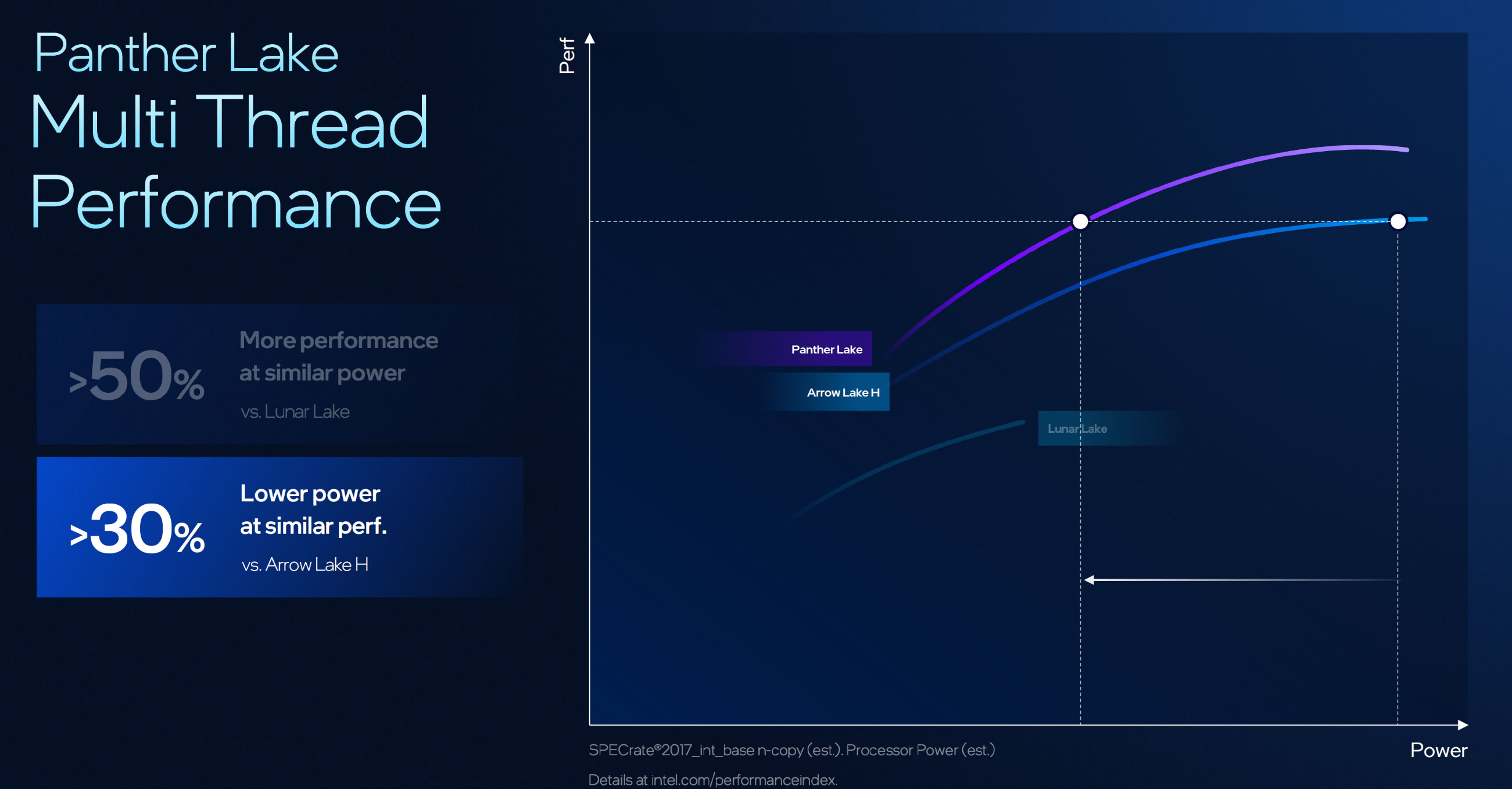
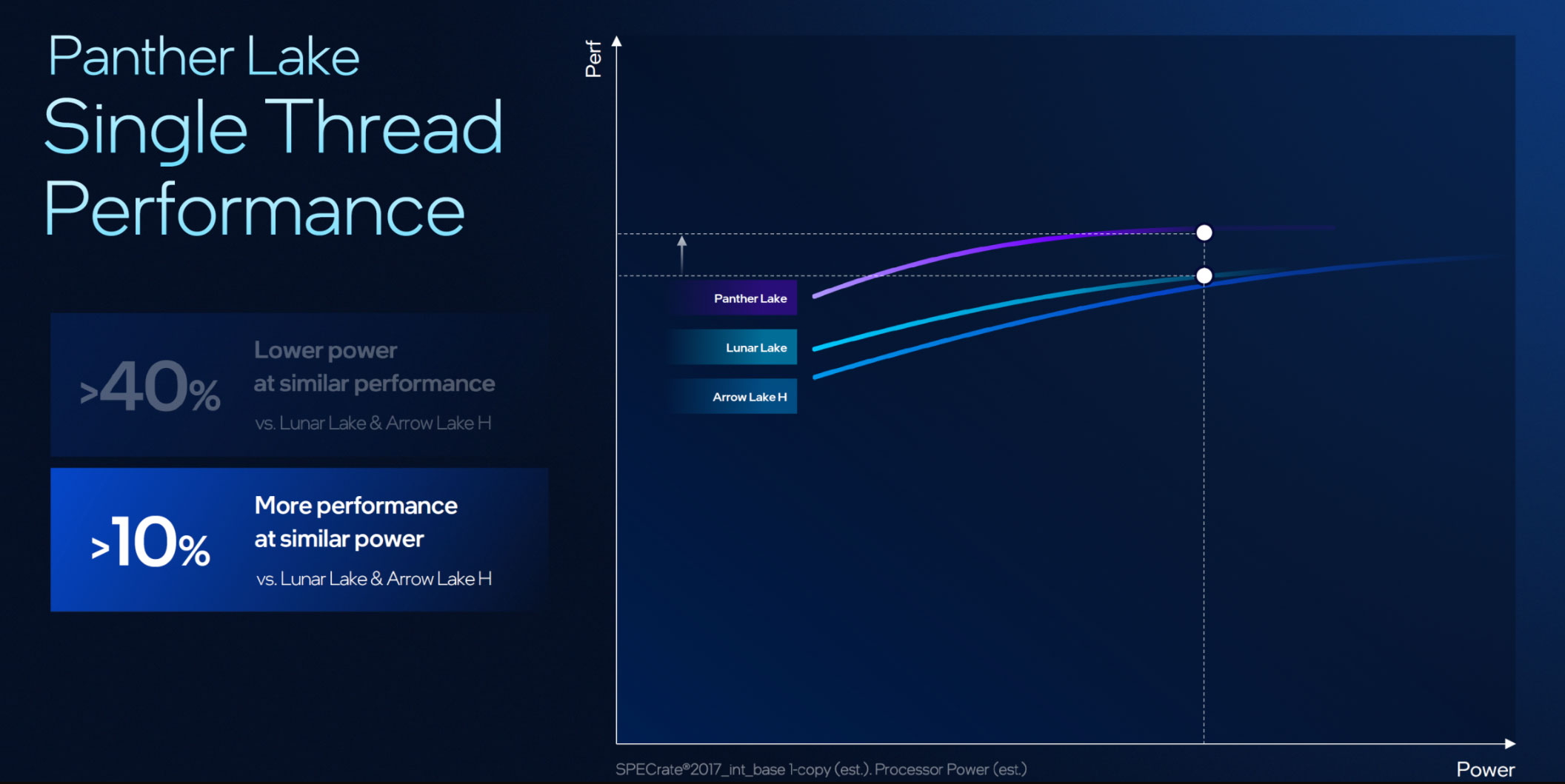
At the end of the day, what Panther Lake promises (and delivers, for the most part) is up to 10% single-core performance over Lunar Lake (and 15% over Arrow Lake), with increased power efficiency.
For multi-threading, Panther Lake offers up to 50% higher performance than Lunar Lake at similar power levels, and a 10-20% performance uplift from Arrow Lake.
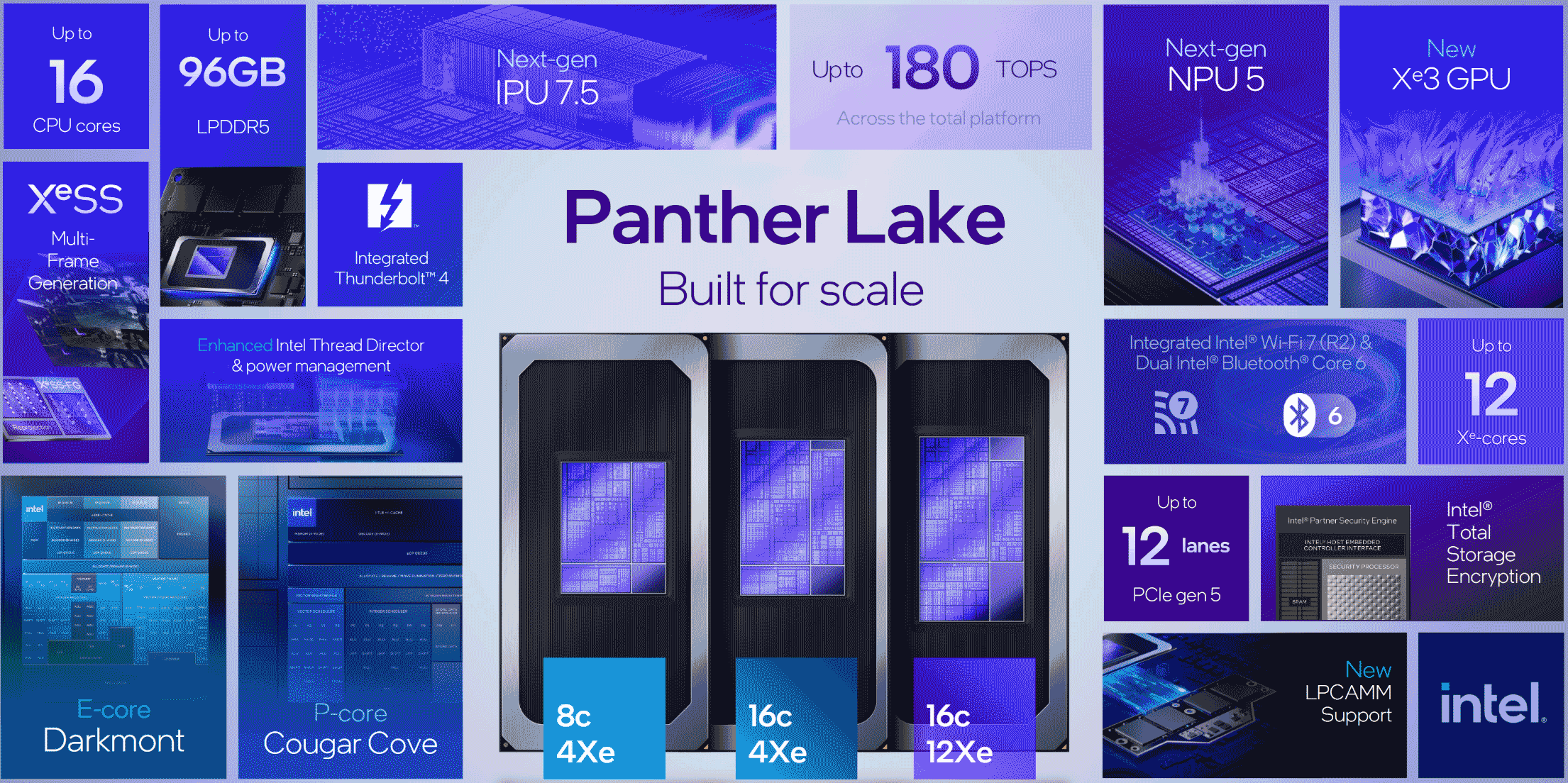
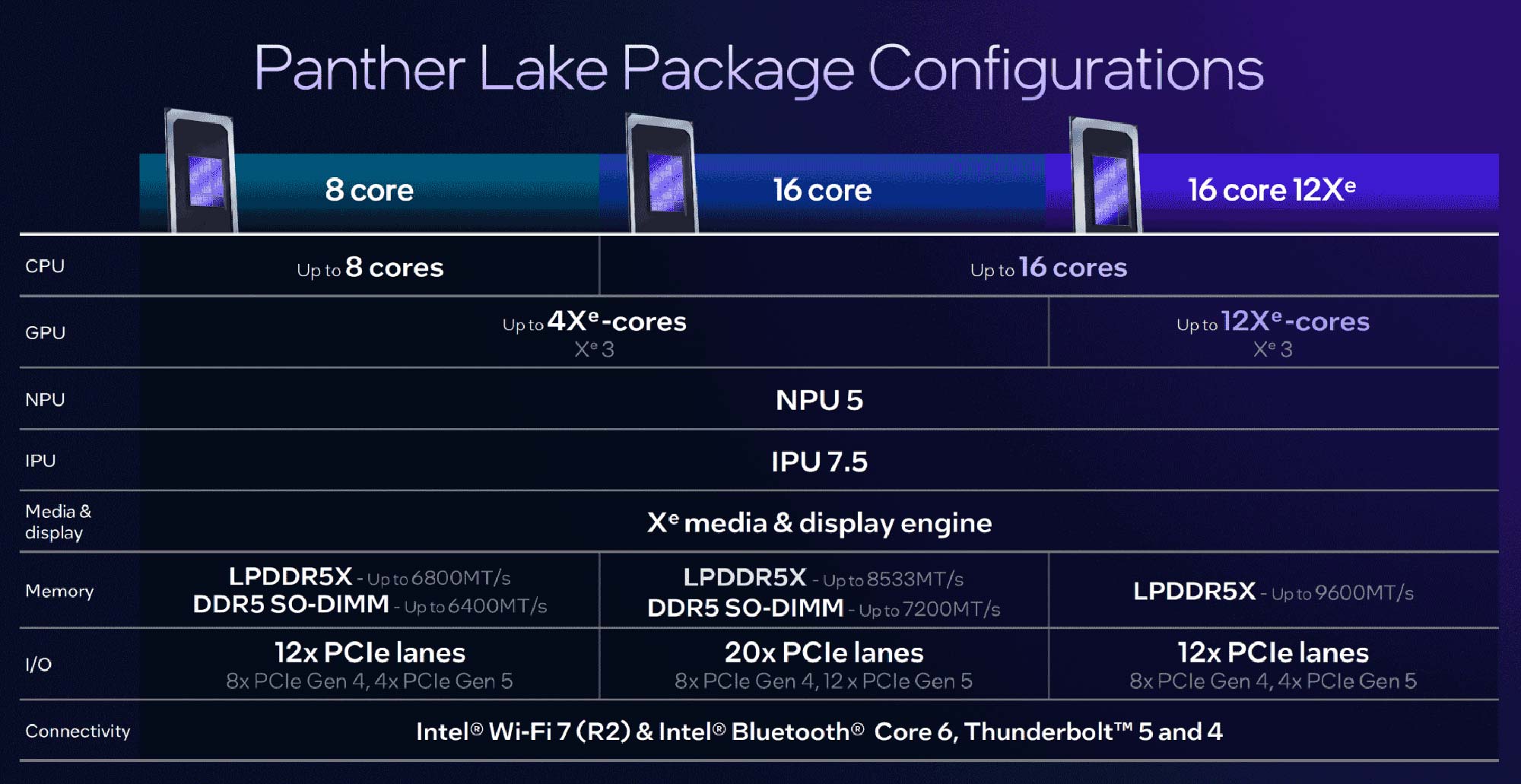
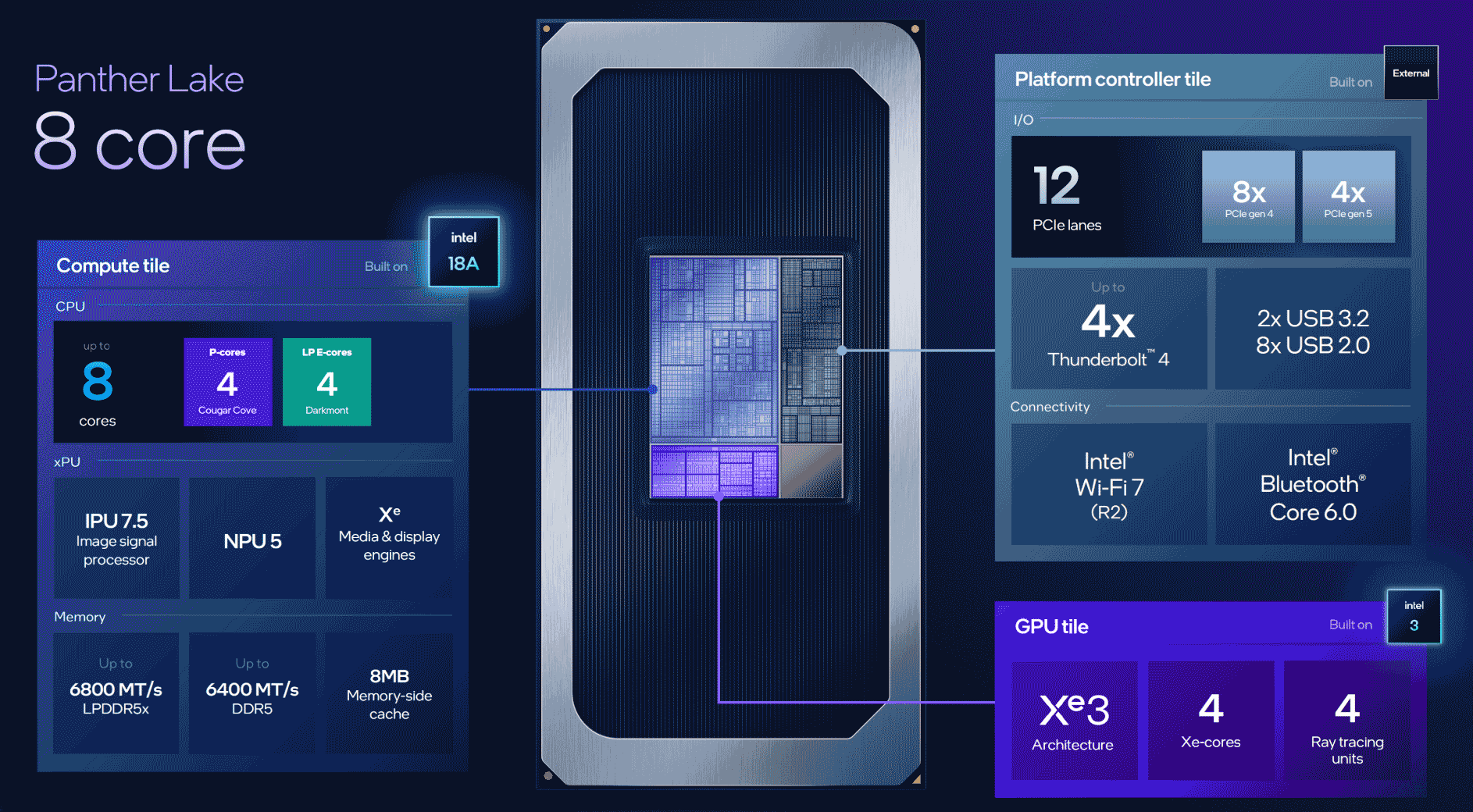
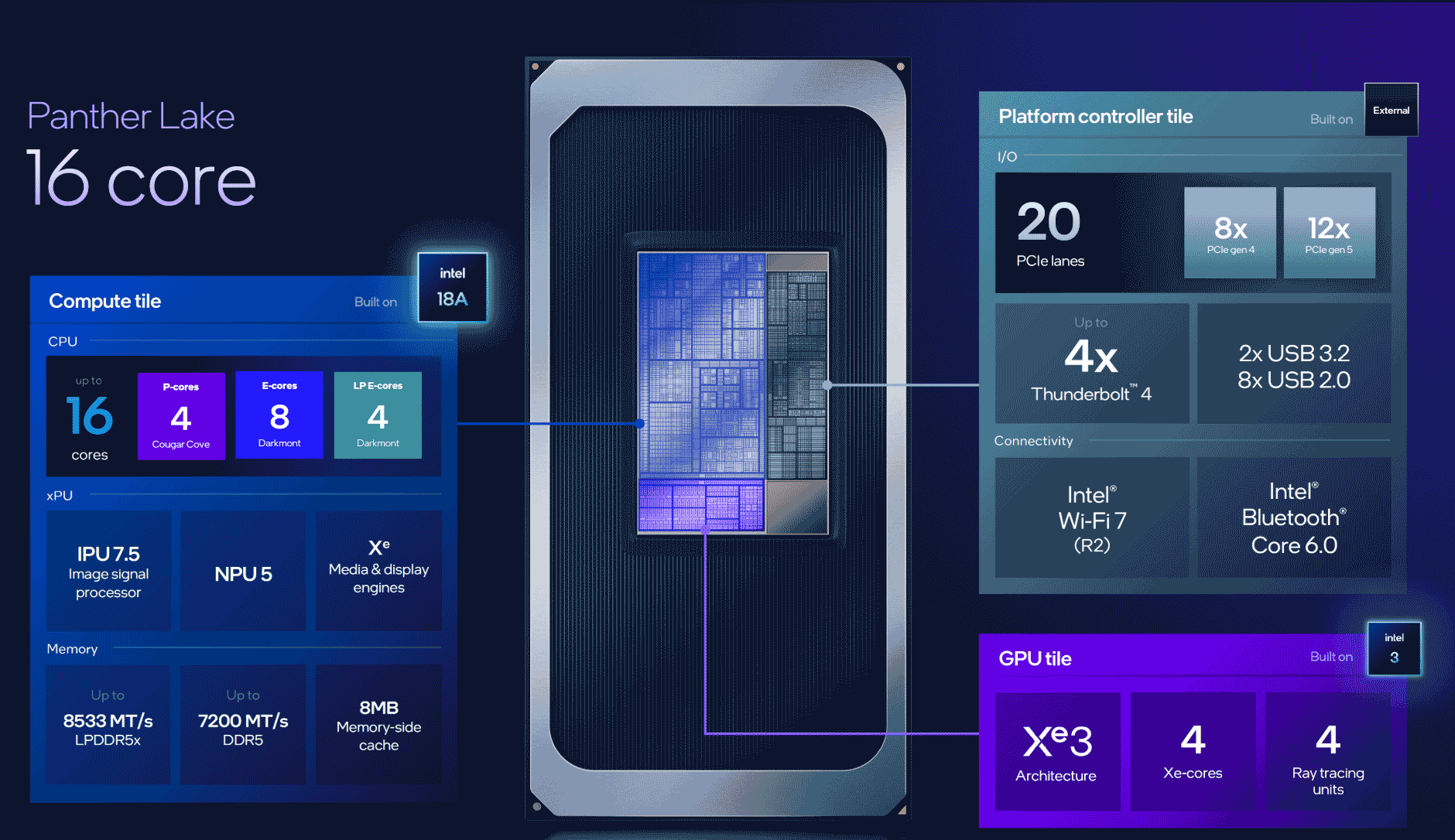
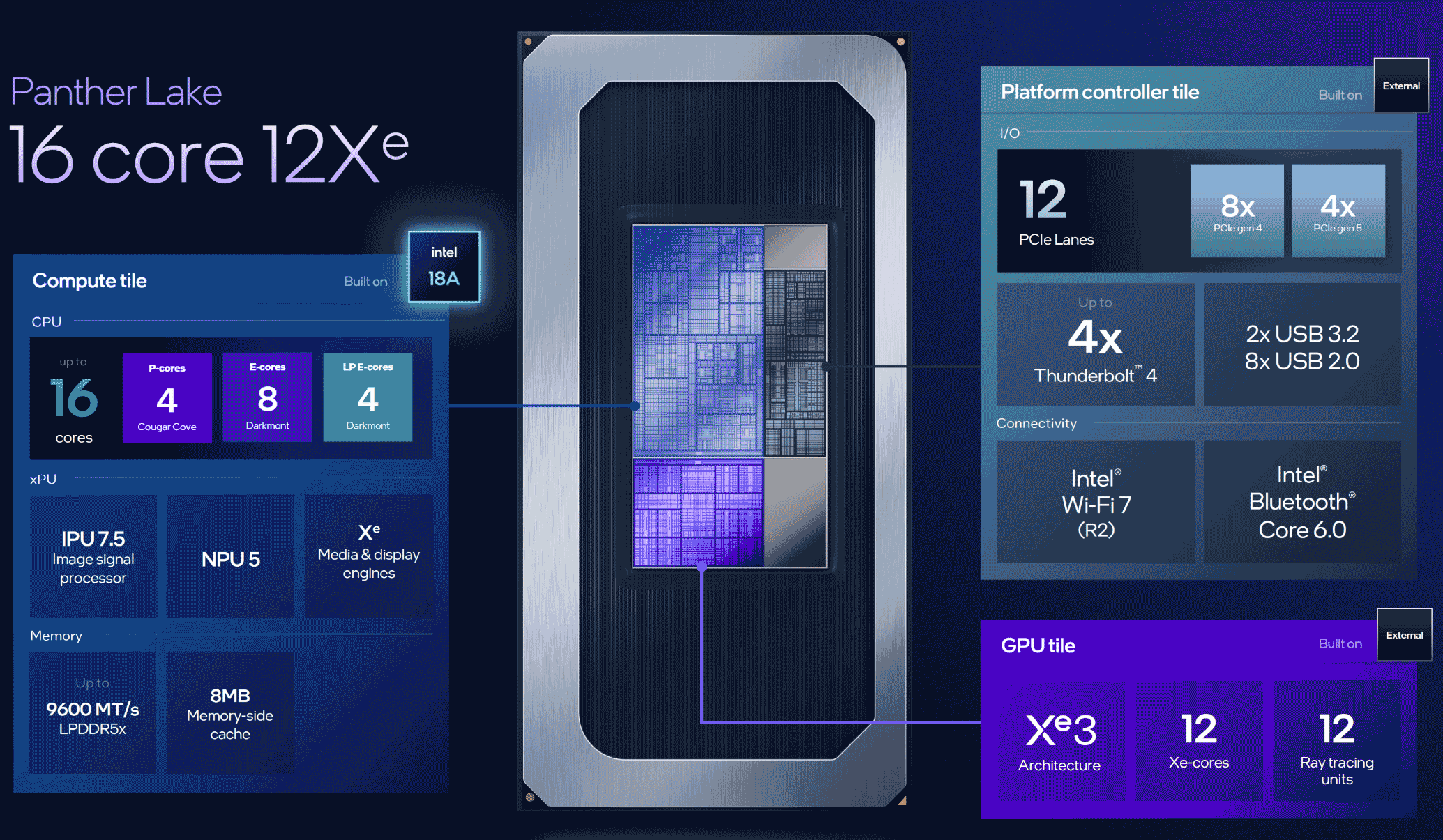
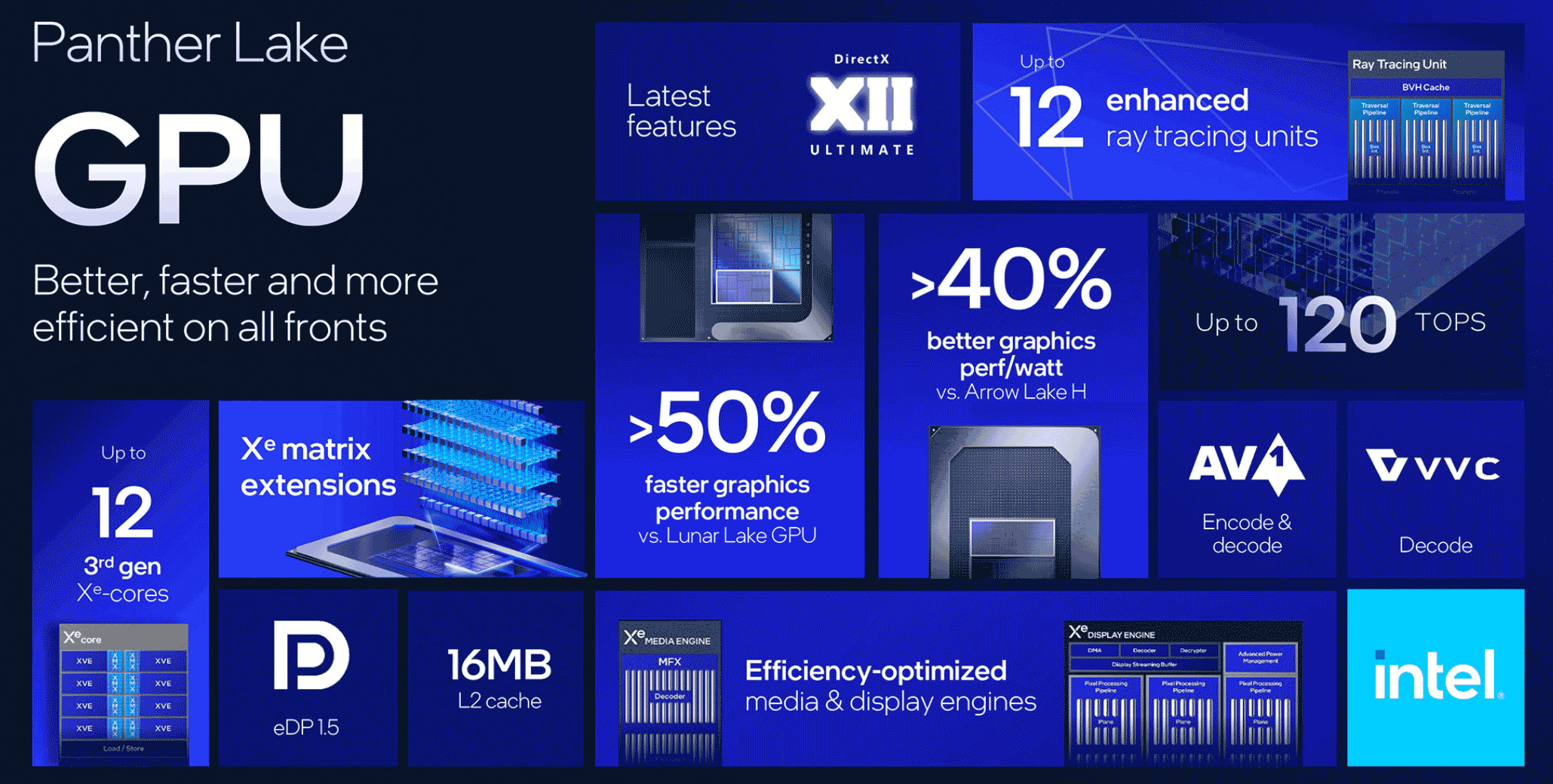
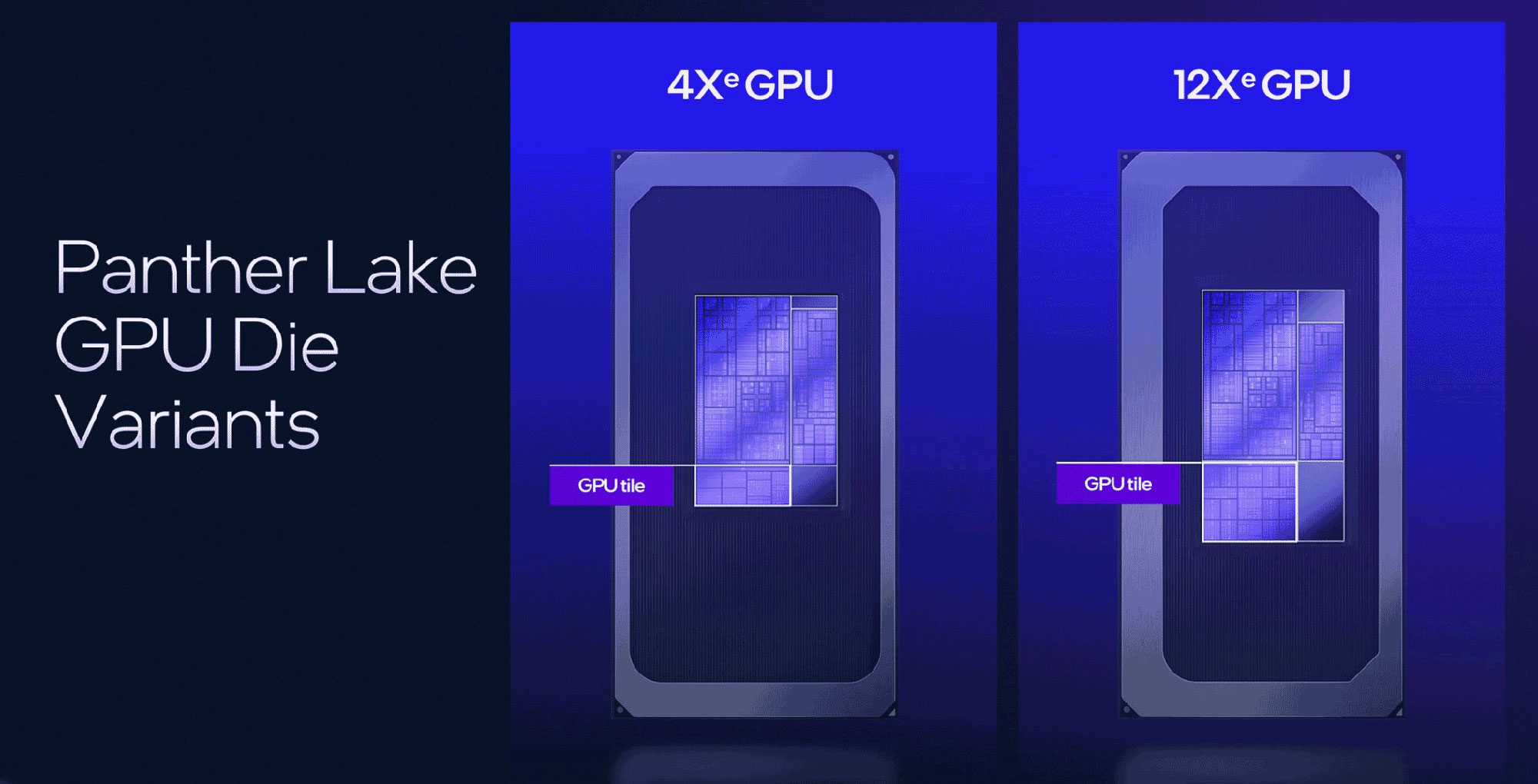
On the GPU side, the series integrates updated Xe3 cores, with either 4, 10 or 12 Cores. The Core Ultra X9 and X7 options get 12 Xe cores with 16 MB of L2 Cache in the Arc B390 chip, there’s also a Core Ultra 5 with 10 Xe cores in the Arc B370 chip (why isn’t this called an Ultra X5, though???), while all the other options integrated a standard Panther Lake iGPU with 4 Xe cores and 4 MB of L2 cache. The 4x iGPU is built on Intel 3 technology, while the 12x iGPU is built with TSMC. The latter also occupies a larger physical space on the processor die.
Furthermore, it’s also important to note that Xe3 cores incorporate Ray Tracing units, as well as Super Sampling with multi-frame generation, a first outside the Nvidia realm so far.
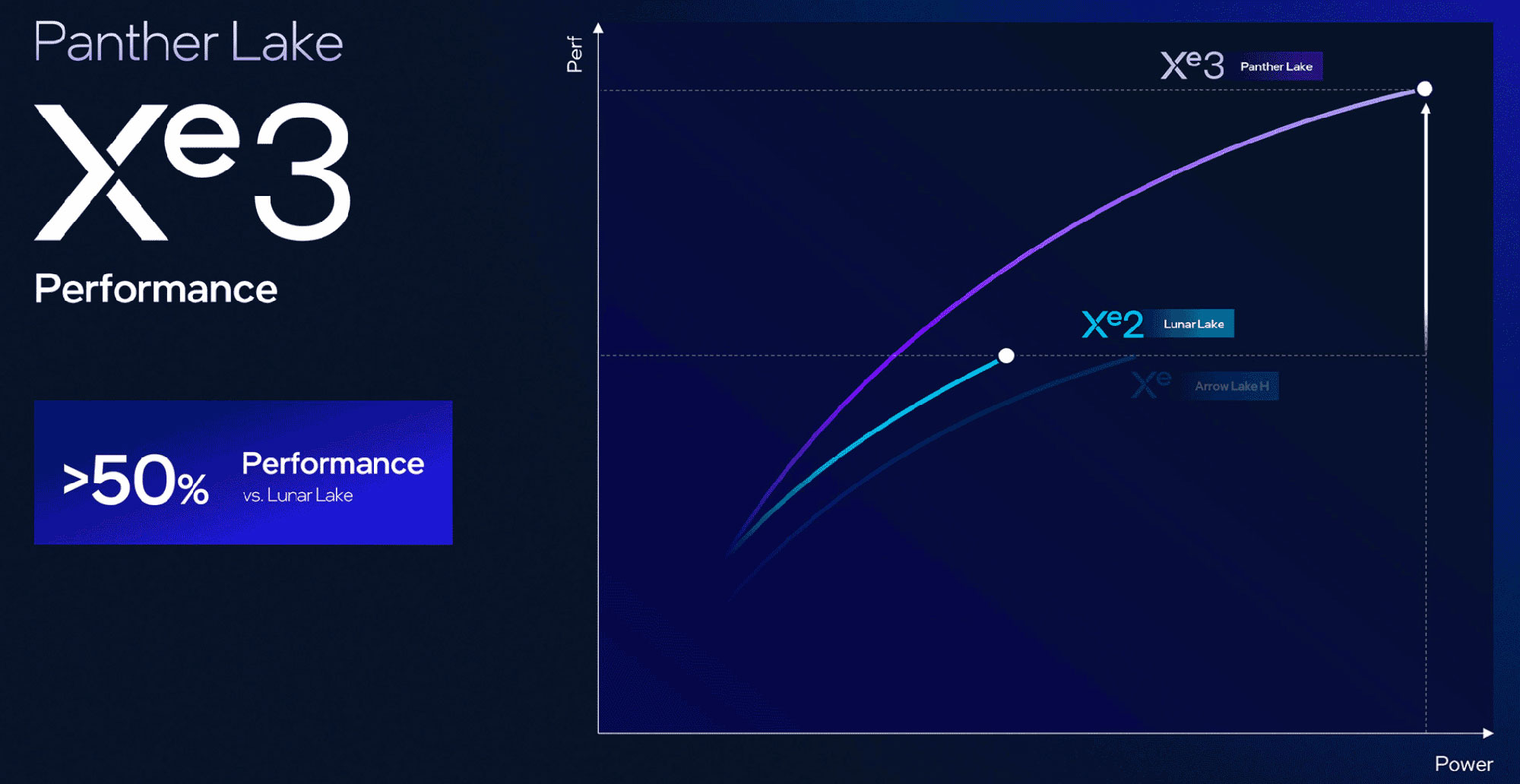
As a whole, the 12x iGPU delivers 50% higher performance than the Arc 140v Lunar Lake iGPU at around 30W of power, and the gains increase slightly at higher power.
With that out of the way, here’s the complete roster of Intel Panther Lake Core Ultra Series 3 hardware.
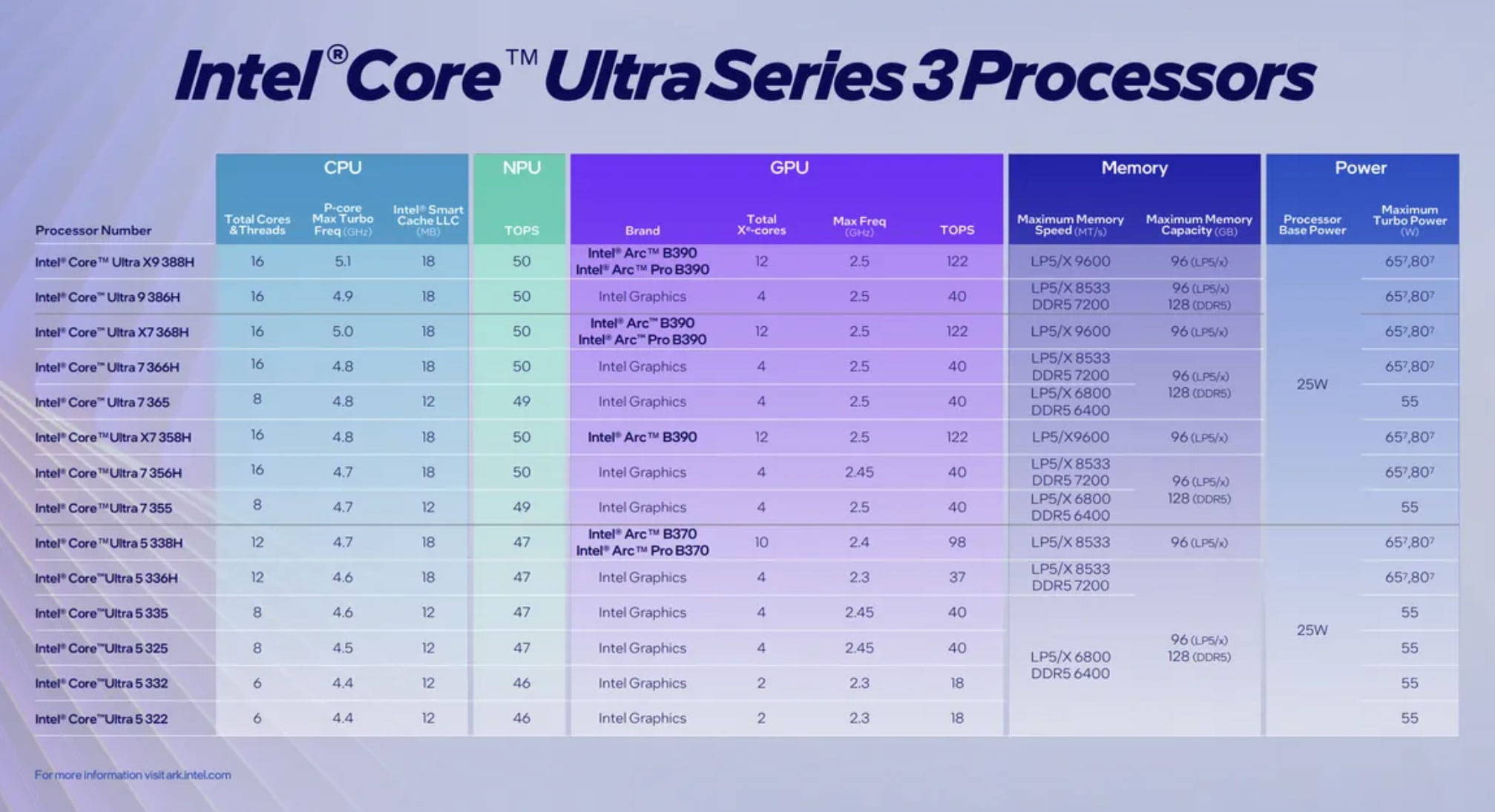
Out of these, the Ultra X7 358H and Ultra X9 388H are the high-performance options with the Arc B390 12x iGPU, the chips that provide the best overall performance in standalone implementations, and the chips we’ll find on the higher-tier models this year.
There’s also the Ultra 5 338H that stands out as an interesting middle-grounder, with a 12 Core CPU and 10C iGPU Intel Arc B370. Rather weird that they didn’t call this an Ultra X5, like the other options with Arc graphics.
Then there are the Ultra 9 386H and Ultra 7 356H, which are either meant as standalone implementations for mainstream portable designs, or bundled with a dGPU for higher-performance laptops. The standalone units aren’t powerful on the CPU side, but offer rather little in graphics capabilities, trailing previous-gen Lunar and Arrow Lake Arc 140V/140T hardware.
And then there are the efficient low-power Ultra 7 365 and Ultra 5 325 options, direct successors for Lunar Lake hardware, with 8 CPU cores and the same 4x cores iGPU. These are fine for casual use and offer efficient runtimes, but don’t get them for serious multitasking and demanding loads.
Here’s a more indepth look at the main Panther Lake SKUs.
| Core Ultra X9 388H | Core Ultra 9 386H | Core Ultra X7 358H | Core Ultra 7 356H | Core Ultra 7 365 | |
| Platform | Panther Lake H | ||||
| Lithography | Intel 18A | ||||
| Design TDP | 15-80 W | 12-55 W | |||
| Cores/Threads | 4P+8E+4LPe/16 | 4P+4LPe/8 | |||
| P-Cores max Turbo | 5.1 GHz | 4.9 GHz | 4.8 GHz | 4.7 GHz | 4.8 GHz |
| E-Cores max Turbo | 4.0 GHz | 3.9 GHz | 3.7 GHz | 5.4 GHz | – |
| LPE-Cores max Turbo | 3.7 GHz | 3.5 GHz | 3.3 GHz | 5.4 GHz | 3.6 GHz |
| Graphics | Intel Arc B390, 12 Xe-3 Cores, up to 2.5 GHz, 122 GPU TOPS |
Intel Graphics, 4 Xe-3 Cores, up to 2.5 GHz, 40 GPU TOPS |
Intel Arc B390, 12 Xe-3 Cores, up to 2.5 GHz, 122 GPU TOPS |
Intel Arc 140T, 8 Xe-2 Cores, up to 2.35 GHz, 74 GPU TOPS |
Intel Graphics, 4 Xe-3 Cores, up to 2.5 GHz, 40 GPU TOPS |
| Cache | 18 MB Smart cache | 12 MB Smart cache | |||
| Memory support |
LPDDR5x-9600, up to 96 GB |
LPDDR5x-8533, DDR5-7200, up to 128 GB |
LPDDR5x-9600, up to 96 GB |
LPDDR5x-8533, DDR5-7200, up to 128 GB |
LPDDR5x-7500, DDR5-6400, up to 128 GB |
| AI Engine |
NPU – 50 TOPS Total – 180 TOPS |
NPU – 50 TOPS Total – 98 TOPS |
NPU – 50 TOPS Total – 180 TOPS |
NPU – 50 TOPS Total – 98 TOPS |
NPU – 49 TOPS Total – 97 TOPS |
And here’s a specs comparison with Arrow Lake H (2025), Lunar Lake V (2024), and Meteor Lake H (2023) platforms.
Just keep in mind that directly comparing these numbers doesn’t make much sense, because while these are all hybrid designs with various amounts of P and E Cores, the actual cores differ between generations, with various improvements and performance/efficiency gains as we move through the generations.
| Core Ultra X9 388H | Core Ultra 9 386H | Core Ultra 9 285H | Core Ultra 7 365 | Core Ultra 258V | Core Ultra 9 185H | |
| Platform | Panther Lake H | Panther Lake H | Arrow Lake H | Panther Lake | Lunar Lake V | Meteor Lake H |
| Lithography | Intel 18A | TSMC N3B | Intel 18A | TSMC N3B | Intel 7 | |
| Design TDP | 15-80 W | 35-115 W | 12-55 W | 8-37 W | 35-115 W | |
| Cores/Threads | 4P+8E+4LPe/16 | 6P+8E+2LPe/16 | 4P+4LPe/8 | 4P+4LPe/8 | 6P+8E+2LPe/22 | |
| P-Cores max Turbo | 5.1 GHz | 4.9 GHz | 5.4 GHz | 4.8 GHz | 4.8 GHz | 5.1 GHz |
| E-Cores max Turbo | 4.0 GHz | 3.9 GHz | 4.5 GHz | – | – | 3.8 GHz |
| LPE-Cores max Turbo | 3.7 GHz | 3.5 GHz | 2.7 GHz | 3.6 GHz | 2.2 GHz | 2.5 GHz |
| Graphics | Intel Arc B390, 12 Xe-3 Cores, up to 2.5 GHz, 122 GPU TOPS |
Intel Graphics, 4 Xe-3 Cores, up to 2.5 GHz, 40 GPU TOPS |
Intel Arc 140T, 8 Xe-2 Cores, up to 2.35 GHz, 74 GPU TOPS |
Intel Graphics, 4 Xe-3 Cores, up to 2.5 GHz, 40 GPU TOPS |
Intel Arc 140V, 8 Xe-2 Cores, up to 1.95 GHz, 64 GPU TOPS |
Intel Arc, 8 Xe-LPG Cores, up to 2.35 GHz |
| Cache | 18 MB Smart cache | 24 MB Smart cache | 12 MB Smart cache | 12 MB Smart cache | 24 MB Smart cache | |
| Memory support |
LPDDR5x-9600, up to 96 GB |
LPDDR5x-8533, DDR5-7200, up to 128 GB |
LPDDR5x-8500, DDR5-6400, up to 128 GB |
LPDDR5x-7500, DDR5-6400, up to 128 GB |
LPDDR5x-8533, up to 32 GB onboard |
LPDDR5x-7467, DDR5-5600, up to 96 GB |
| AI Engine |
NPU – 50 TOPS Total – 180 TOPS |
NPU – 50 TOPS Total – 98 TOPS |
NPU – 13 TOPS Total – 99 TOPS |
NPU – 49 TOPS Total – 97 TOPS |
NPU – 47 TOPS Total – 115 TOPS |
NPU – 11 TOPS Total – ?? |
Panther Lake Performance – Core X9 388H, Core X7 358H vs. Arrow Lake Core Ultra 9 285H, Lunar Lake Core Ultra 7 258, AMD Ryzen AI 9 HX 370
As we’re running our tests and reviews, here’s a brief analysis of the performance you should expect from the higher-tier Intel Panther Lake hardware we’ve tested so far (with updates to follow), next to similar implementations of Arrow Lake, Lunar Lake, and Strix Point (with Gorgon Point being identical) platforms.
Note: These tests are running on the BIOS and drivers available in late-January 2026.
| ExpertBook Ultra B9406, Panther Lake Intel Core Ultra X7 358H + B390, 45W Performance mode |
ExpertBook Ultra B9406, Panther Lake Intel Core Ultra X7 358H + B390, 30W Standard mode |
Zenbook S14 UX5406, Panther Lake Intel Core Ultra 9 386H + Intel, 28W Performance mode |
Zenbook S14 UX5406, Lunar Lake Intel Core Ultra 7 258V + Arc 140V, ~24W Performance mode |
Zenbook 14 UX3405, Arrow Lake Intel Core Ultra 9 285H + Arc 140T, 30W Performance mode |
Zenbook S 16 UM6506, Strix/Gorgon Point AMD Ryzen AI 9 HX 370 + Rad 890M, 33W Full Speed mode |
|
| 3DMark – Fire Strike | 14292 (G – 17035, P – 28231, C – 4848) | 13342 (G – 16080, P – 26181, C – 4429) | 6576 (G – 7195, P – 27882, C – 2356) | 8993 (G – 9984, P – 21713, C – 3429) | 8629 (G – 9307, P – 27479, C – 3351) | 7505 (G – 7946, P – 25618, C – 3031) |
| 3DMark – Time Spy | 7529 (Graphics – 6945, CPU – 14384) | 6842 (Graphics – 6358, CPU – 12037) | 3429 (Graphics – 3051, CPU – 11583) | 4443 (Graphics – 4155, CPU – 7323) | 4472 (Graphics – 4036, CPU – 11560) | 3598 (Graphics – 3241, CPU – 9599) |
| Uniengine Superposition – 1080p Extreme | 3779 | 3626 | 1656 | 2108 | 2403 | 1600 |
| CineBench R23 (best run) | 19809 cb – multi core, 2051 cb – single core |
17334 cb – multi core, 2055 cb – single core |
17054 cb – multi core, 2081 cb – single core |
9930 cb – multi core, 1855 cb – single core |
15812 cb – multi core, 2100 cb – single core |
17484 cb – multi core, 1950 cb – single core |
| Blender 4.3.2 – Classroom scene – CPU Compute | 5m 42s | 6m 47s | 6m 58s | 11m 43s | 7m 00s | 5m 12s |
| PugetBench – DaVinci After Effects | – | – | – | 530 | – | 688 |
| SPECviewperf 2020 – 3DSMax: | 38.15 | 37.82 | 18.18 | 23.69 | 29.17 | 40.95 |
| SPECviewperf 2020 – Catia: | 30.14 | 30.18 | 15.11 | 18.94 | 23.20 | 33.25 |
| SPECviewperf 2020 – Maya: | 155.74 | 156.71 | 84.37 | 98.87 | 117.12 | 125.32 |
You can tell how the CPU performance scales between generations, with notable gains in multi-threaded performance for the Panther Lake options, even compared to the Arrow Lake implementation. AMD’s Strix/Gorgon Point hardware remains competitive, but still 10-15% behind Panther Lake.
On the GPU side, the Arc B390 implementations are in a class of their own, and even a mid-powered 30W implementation delivers about 90% of the potential graphics performance. From our tests, a 35W power settings deliver max graphics performance and ~90% of the CPU performance possible at higher power with these chips.
Compared to Radeon and previous-gen Intel Xe iGPUs, the B390 holds a significant advantage for 40-50% in our test, but the 4x iGPU is much slower at about 40% of the Arc B390 scores, and about on par with the Radeon 890M.
However, the beefier Radeon iGPUs offered with AMD’s Strix Halo and the entry-tier Nvidia chips (RTX 4050/5050) are still faster performers, as we’ll discuss in a different article. But for what is worth, those also require more power for full capabilities.
Panther Lake Gaming Performance
We also ran a couple of games on these platforms, at FHD+ resolution, with Low/Lowest graphics settings. Here’s what we got.
— updating the results for the Ultra 9 386H
| Low settings | ExpertBook Ultra 2026, Ultra X7 385H, Arc B390, Perf – 45W, FHD+ 1200p |
ExpertBook Ultra 2026, Ultra X7 385H, Arc B390, Standard – 30W, FHD+ 1200p |
Zenbook S14 2026, Ultra 9 386H, Intel, Perf – 28W, FHD+ 1200p |
Zenbook 14 2025, Ultra 9 285H, Arc 140T, Perf – 30W, FHD+ 1200p |
Zenbook S14 2024, Ultra 7 258V, Arc 140V, Full – 28W, FHD+ 1200p |
Zenbook S 16 2024, Ryzen AI 9 370, Rad 890m, Full – 33W, FHD+ 1200p |
| Cyberpunk 2077 (DX12, Low Preset) |
54 fps (36 fps – 1% low) | 52 fps (34 fps – 1% low) | 24 fps (12 fps – 1% low) | – | – | – |
| Cyberpunk 2077 (DX12, Low Preset, XeSS, FG) |
118 fps (54 fps – 1% low) | 114 fps (54 fps – 1% low) | 56 fps (26 fps – 1% low) | – | – | – |
| Far Cry 6 (DX11, Low Preset, TAA) |
90 fps (70 fps – 1% low) | 72 fps (54 fps – 1% low) | 48 fps (40 fps – 1% low) | 52 fps (36 fps – 1% low) | 52 fps (38 fps – 1% low) | 54 fps (46 fps – 1% low) |
| Horizon Forbidden West (DX12, Very Low Preset, TAA, Upscale Off) |
72 fps (56 fps – 1% low) | 70 fps (54 fps – 1% low) | 46 fps (38 fps – 1% low) | 44 fps (30 fps – 1% low) | 45 fps (32 fps – 1% low) | 40 fps (30 fps – 1% low) |
| Shadow of Tomb Raider (DX12, Lowest Preset, no AA) |
103 fps (58 fps – 1% low) | 102 fps (57 fps – 1% low) | 62 fps (45 fps – 1% low) | 72 fps (48 fps – 1% low) | 66 fps (26 fps – 1% low) | 72 fps (56 fps – 1% low) |
| The Witcher 3: Wild Hunt (DX 11/12, Low Preset, TUAA) |
110 fps (75 fps – 1% low) | 108 fps (75 fps – 1% low) | 74 fps (50 fps – 1% low) | 66 fps (54 fps – 1% low) | 78 fps (56 fps – 1% low) | 60 fps (38 fps – 1% low) |
Once more, the Arc B390 outpaces everything else by a wide margin. We’ll discuss how it fares against the Radeon 8060S Strix Halo iGPU in a separate article.
And keep in mind I haven’t activated XeSS or frame-generation for any of these tests. These technologies make a notable difference where supported – for instance, the framerates jump to around 110 fps in Cyberpunk with XeSS and FG switched on.
You’ll find more details in our reviews, linked down below as we finalize our tests.
List of all laptops built on the Intel Panther Lake hardware (Core Ultra Series 3)
This section lists all the available notebooks built on Panther Lake Core Ultra 7/9 Series 3 hardware.
However, I’ve split them into three different categories:
- portable performance laptops built on Core Ultra X7/X9 hardware with the Arc B390 12x iGPU;
- ultraportable and mid-range options built on Core Ultra hardware, with either the higher performance 16C, 4x iGPU options (Arrow Lake H follow-ups), or the efficient 8c, 4x iGPU variants (Lunar Lake V follow-ups).
- high-performance models that bundle Core Ultra hardware with Nvidia dGPUs.
So here we go. First, the Ultra X9 388H or Ultra X7 358H premium ultraportables (for what it is worth, the differences in real-life capabilities between these two chips are minimal to none).
There are many highly-interesting options in this tier, starting with the Asus ExpertBook Ultra, Lenovo ThinkPad X1 Carbon and Lenovo ThinkPad X9 15P pro-tier business laptops, and continuing with the refreshed Dell XPS, Lenovo Yoga Slim Ultra and Asus Zenbook DUO lineups. If you have the budget (2000+ USD/EUR) and are looking for a competent premium daily driver, this is where you’ll most likely find it.
| Model | Format, Features, Weight | Screen | Hardware and particularities | Battery |
| Acer Swift 16 AI | premium portable laptop, all-metal build, 1.55 kg / 3.42 lbs |
16″ OLED, touch 3K 120Hz, 180-hinge |
up to Core Ultra X9 388H, max 32 GB LPDDR5x RAM, 1x M.2 SSD, haptic touchpad with pen support |
70 Wh |
| Acer Swift GO 14 AI | mid-tier portable laptop, all-metal build, 1.15 kg / 2.5 lbs |
14″ OLED, touch or non-touch up to 3K 120Hz, 180-hinge |
up to Core Ultra X9 388H, 45W, max 32 GB LPDDR5x RAM, 1x M.2 SSD |
71 Wh |
| Acer Swift GO 16 AI | mid-tier portable laptop, all-metal build, 1.6 kg / 3.5 lbs |
16″ OLED, touch or non-touch 2K 60Hz, 180-hinge |
up to Core Ultra X9 388H, 45W, max 32 GB LPDDR5x RAM, 1x M.2 SSD |
70 Wh |
| Asus ExpertBook Ultra | premium business laptop, ultralight metal build, .99 kg / 2.2 lbs |
14″ tandem OLED, non-touch, anti glare – Gorilla Matte, 3K 120Hz VRR, 1400 nits peak, 180-hinge |
up to Core Ultra X7 358H, 50W TDP, max 64 GB LPDDR5x RAM, 1x M.2 gen5 SSD, haptic touchpad, 2x speakers dual-fan dual-heatpipe cooling |
70 Wh |
| Asus Zenbook Duo | dual-display laptop, all-metal build, standalone keyboard folio; from 1.65 kg / 3.65 lbs |
dual 14″ OLED, touch, 3K 144Hz VRR, 180-hinge |
up to Core Ultra X9 388H, 45W TDP, max 32 GB LPDDR5x RAM, 1x M.2 SSD, updated cooling, 6x speakers |
99 Wh |
| Dell XPS 14 | ultrabook, premium metal build, from 1.36 kg / 3 lbs |
14″ IPS or OLED, IPS 2K matte, OLED 3K 120Hz touch |
up to Core Ultra X9 388H, 25W TDP, max 64 GB LPDDR5x RAM, 1x M.2 gen5 SSD, updated keyboard, haptic touchpad, USB-C only IO, 4x speakers |
70Wh |
| Dell XPS 16 | ultrabook, premium metal build, from 1.65 kg / 3.65 lbs |
16″ IPS or OLED, IPS 2K matte, OLED 3K 120Hz touch |
up to Core Ultra X9 388H, 35W TDP, max 64 GB LPDDR5x RAM, 1x M.2 gen5 SSD, updated keyboard without NumPad, haptic touchpad, USB-C only IO, 4x speakers |
70Wh |
| HP Omnibook Ultra 14 | ultrabook, metal build, from 1.3 kg / 2.85 lbs |
14″ OLED, 2.8K 120Hz glossy 1100-nits peak |
up to Core Ultra X9 388H, max 32 GB LPDDR5x RAM, 1x M.2 SSD 4x speakers, 5MP camera |
70Wh |
| Lenovo IdeaPad Pro 5i 14 | mid-tier creator laptop, all metal build, from 1.45 kg / 3.2 lbs |
14″ OLED, touch 2.8K 120Hz VRR, 600 nits peak 170-hinge |
up to Core Ultra X9 388H, max 32 GB LPDDR5x RAM, 1x M.2 gen5 SSD 2x speakers |
84 Wh |
| Lenovo ThinkPad X1 Carbon | premium business laptop, all metal build, from 1 kg / 2.2 lbs |
14″ IPS or OLED, IPS 2K matte, OLED 3K 120Hz VRR, 180-hinge |
up to Core Ultra X7 358H, 30W TDP, max 64 GB LPDDR5x RAM, 1x M.2 gen5 SSD, updated chassis design and cooling, haptic touchpad, 2x speakers |
58 Wh |
| Lenovo ThinkPad X1 2-in-1 | premium business laptop, 2-in-1 format, all metal build, from 1.18 kg / 2.6 lbs |
14″ OLED touch, 3K 120Hz VRR anti-glare, 360-hinge |
up to Core Ultra X7 358H, 30W TDP, max 64 GB LPDDR5x RAM, 1x M.2 gen5 SSD, updated chassis design and cooling, haptic touchpad, 2x speakers |
58 Wh |
| Lenovo ThinkPad X9 | premium ultrabook, all metal build, from 1.4 kg /3.1 lbs |
15.3″ OLED, touch or non-touch, 3K 120Hz, 180-hinge |
up to Core Ultra X9 388H, 45W TDP, max 64 GB LPDDR5x RAM, 1x M.2 gen5 SSD, haptic touchpad, 6x speakers |
88 Wh |
| Lenovo Yoga Slim 7i Ultra Aura Edition |
ultrabook, premium metal build, magnesium alloy, from 1 kg / 2.2 lbs |
14″ OLED, 2.8K 120Hz, 1100 nits peak |
up to Core Ultra X9 388H, ??W TDP, max 32 GB LPDDR5x RAM, 1x M.2 gen5 SSD, low travel keyboard, minimalist USB-C only IO, glass forcepad, 4x speakers |
75 Wh |
| LG Gram 16 | premium ultrabook, all-metal build, from 1.2 kg / 2.65 lbs |
16″ OLED, glossy, 2.8K 120Hz VRR, non-touch |
up to Core Ultra X7 358H, max 32 GB LPDDR5x RAM, 1x M.2 SSD |
77 Wh |
| MSI Prestige 13 AI+ | ultrabook, all metal build, from .9 kg / 2 lbs |
13.3″ OLED, 2K 60Hz, 180-hinge |
up to Core Ultra X7 358H, ?? TDP, max 64 GB LPDDR5x RAM, 1x M.2 gen4 SSD, 2x speakers |
54 Wh |
| MSI Prestige 14 AI+ | ultrabook, all metal build, from 1.32 kg / 3 lbs |
14″ OLED, 2K 60Hz, 180-hinge |
up to Core Ultra X7 358H, ?? TDP, max 64 GB LPDDR5x RAM, 1x M.2 gen4 SSD, 4x speakers |
81 Wh |
| MSI Prestige 16 AI+ | portable laptop, mostly metal build, from 1.6 kg / 3.5 lbs |
16″ OLED, 3K 120Hz VRR, 180-hinge |
up to Core Ultra X9 388H, ?? TDP, max 64 GB LPDDR5x RAM, 1x M.2 gen5 SSD, 4x speakers |
81 Wh |
| MSI Prestige 16 Flip AI+ | portable 2-in-1 laptop, mostly metal build, from 1.66 kg / 3.65 lbs |
16″ OLED, touch, 3K 120Hz VRR, 360-hinge |
up to Core Ultra X9 388H, ?? TDP, max 64 GB LPDDR5x RAM, 1x M.2 gen5 SSD, 4x speakers |
81 Wh |
| Samsung Galaxy Book6 Pro 14 | premium ultrabook, all-metal build, from 1.24 kg / 2.75 lbs |
14″ AMOLED, anti-ref 2.8K 120Hz, 1100 nits peak |
up to Core Ultra X7 358H, max 32 GB LPDDR5x RAM, 1x M.2 gen5 SSD |
67 Wh |
| Samsung Galaxy Book6 Pro 16 | premium ultrabook, all-metal build, from 1.6 kg / 3.5 lbs |
16″ AMOLED, anti-ref 2.8K 120Hz |
up to Core Ultra X7 358H, max 32 GB LPDDR5x RAM, 1x M.2 gen5 SSD |
78 Wh |
Most of these lineups mentioned earlier are also available with the lower-tier hardware.
However, some of the most compact, thin, and lightweight options or some of the more affordable options are only offered with Core Ultra 300 (up to Core Ultra 7 356) and Core Ultra 300H (up to Core Ultra 9 386H) specs, without the top-end iGPU (both because the X7/X9 SKUs are expensive and because they require more power to run at proper capacity). These options are listed further down.
Most of these devices are mid-tier options and the more affordably-priced Panther Lake configurations you’ll find in stores these days. The Acer Swift Edge and Asus Zenbook S14 models stand out as exceptions, as more premium devices not offered with Ultra X specs – they’re still excellent daily-drivers as long as graphics capabilities are not that important to you.
| Model | Format, Features, Weight | Screen | Hardware and particularities | Battery |
| Acer Swift Edge 14 AI | premium ultrabook, lightweight metal build, .99 kg / 2.2 lbs |
14″ OLED, glossy non-touch, 2K 60Hz or 3K 120Hz, 180-hinge |
up to Core Ultra 9 386H, max 32 GB LPDDR5x RAM, 1x M.2 gen4 SSD |
65 Wh |
| Acer Swift Edge 16 AI | premium ultrabook, lightweight metal build, 1.25 kg / 2.8 lbs |
16″ OLED, non-touch or touch 2K 60Hz or 3K 120Hz, 180-hinge |
up to Core Ultra 9 386H, max 32 GB LPDDR5x RAM, 1x M.2 gen4 SSD |
65 Wh |
| Acer Aspire 14 AI | mid-tier portable laptop, part metal build, 1.4 kg / 3.1 lbs |
14″ IPS or OLED, touch or non-touch up to 3K 120Hz, 180-hinge |
up to Core Ultra 9 386H, max 32 GB LPDDR5x RAM, 1x M.2 gen4 SSD |
65 Wh |
| Acer Aspire 16 AI | mid-tier portable laptop, part-metal build, 1.52 kg / 3.35 lbs |
16″ IPS or OLED, touch or non-touch up to 3K 120Hz, 170-hinge |
up to Core Ultra 9 386H, max 32 GB LPDDR5x RAM, 1x M.2 gen4 SSD |
65 Wh |
| Asus ExpertBook B3 G2 14 | business laptop, part metal build, 1.4 kg / 3.1 lbs |
14″ 16:10 IPS, matte up to 2.5K 144Hz |
up to Core Ultra 7 vPro 366H, max 96 GB DDR5, 2xDIMMs, 2x M.2 SSDs |
50,63 Wh |
| Asus ExpertBook B3 G2 16 | business laptop, part metal build, 1.8 kg / 4 lbs |
16″ 16:10 IPS, matte up to 2.5K 144Hz |
up to Core Ultra 7 vPro 366H, max 96 GB DDR5, 2xDIMMs, 2x M.2 SSDs |
50,63 Wh |
| Asus ExpertBook B5, P5 G2 14 | business laptop, metal build, 1.4 kg / 3.1 lbs |
14″ 16:10 IPS, matte up to 2.5K 144Hz |
up to Core Ultra 7 vPro 366H, max 64 GB LPDDR5x onboard, 1x M.2 SSD |
70 Wh |
| Asus ExpertBook B5, P5 G2 16 | business laptop, metal build, 1.8 kg / 4 lbs |
16″ 16:10 IPS, matte 2.5K 144Hz |
up to Core Ultra 7 vPro 366H, max 64 GB LPDDR5x onboard, 1x M.2 SSD |
70 Wh |
| Asus Zenbook S14 UX5406 |
premium ultrabook, ultralight metal build, 1.2 kg / 2.7 lbs |
14″ OLED, glossy touch or non-touch, 3K 120Hz VRR, 1100 nits peak, 130-hinge |
up to Core Ultra 7 386H, 35W TDP; max 32 GB LPDDR5x RAM, 1x M.2 gen4 SSD, haptic touchpad, 4x speakers updated vapor-chamber cooling |
77 Wh |
| Asus Vivobook S14 S3407 |
mid-tier ultrabook, metal build, 1.4 kg / 3.1 lbs |
14″ OLED, glossy non-touch, 2K 60Hz, 180-hinge |
up to Core Ultra 7 355, max 32 GB DDR5 RAM, 16GB onboard 1x DIMM, 1x M.2 gen4 SSD |
70 Wh |
| Asus Vivobook S16 S3607 |
mid-tier ultrabook, metal build, 1.7 kg / 3.8 lbs |
16″ OLED, glossy non-touch, 2K 60Hz, 180-hinge |
up to Core Ultra 7 355, max 32 GB DDR5 RAM, 16GB onboard 1x DIMM, 1x M.2 gen4 SSD |
70 Wh |
| Asus Vivobook 14 X1407 |
entry-tier ultrabook, part metal build, 1.45 kg / 3.2 lbs |
14″ IPS, matte non-touch, 2K 60Hz, 180-hinge |
up to Core Ultra 5 325, max 32 GB DDR5 RAM, 16GB onboard 1x DIMM, 1x M.2 gen4 SSD |
42, 70 Wh |
| Asus Vivobook 16 X1607 |
entry-tier ultrabook, part metal build, 1.9 kg / 4.2 lbs |
16″ IPS, matte non-touch, 2K 60Hz, 180-hinge |
up to Core Ultra 5 325, max 32 GB DDR5 RAM, 16GB onboard 1x DIMM, 1x M.2 gen4 SSD |
42, 70 Wh |
| Lenovo ThinkBook Plus 14 | mid-tier business laptop, all metal build, from 1.4 kg / 3.1 lbs |
14″ OLED, touch 2.8K 120Hz, 500-nits, 180-hinge |
up to Core Ultra 7 355, max 32 GB LPDDR5x RAM, 1x M.2 gen5 SSD, 4x speakers |
75 Wh |
| LG Gram 17 | premium ultrabook, all-metal build, from 1.38 kg / 3.05 lbs |
17.3″ IPS, matte, 2.5K 60Hz, non-touch |
up to Core Ultra 7 355, max 32 GB LPDDR5x RAM, 1x M.2 SSD |
77 Wh |
| LG Gram 15 | premium ultrabook, all-metal build, from 1.3 kg / 2.9 lbs |
15.6″ IPS, matte, 2K 60Hz, non-touch |
up to Core Ultra 7 355, max 32 GB LPDDR5x RAM, 1x M.2 SSD |
72 Wh |
| LG Gram 14 | premium ultrabook, all-metal build, from 1.12 kg / 2.5 lbs |
14″ IPS, matte, 2K 60Hz, non-touch |
up to Core Ultra 7 355, max 32 GB LPDDR5x RAM, 1x M.2 SSD |
72 Wh |
| Samsung Galaxy Book6 14 | mid-tier ultrabook, part metal build, from 1.5 kg / 3.3 lbs |
14″ IPS matte 2K 60H |
up to Core Ultra 7 355H, max 32 GB LPDDR5x RAM, 1x M.2 gen5 SSD |
61 Wh |
| Samsung Galaxy Book6 16 | mid-tier ultrabook, part metal build, from 1.75 kg / 3.85 lbs |
16″ IPS matte or touch 2K 60H |
up to Core Ultra 7 355H, max 32 GB LPDDR5x RAM, 1x M.2 gen5 SSD |
61 Wh |
Finally, these are the higher-performance laptops with Core Ultra 300H + RTX 5000 hardware.
The majority of these are 16-inch formats, with some more compact 14 and 15-inch variants.
These notebooks are all premium-tier offers that should meet most expectations. Among them, the Asus ROG Zephyrus models stand out with their higher-power GPU configurations, while the Lenovo Yoga Pro and the Samsung Galaxy Book6 Ultra have what it takes to become prime alternatives to the versatile Apple MacBook Pro 16.
| Model | Format, Features, Weight | Screen | Hardware and particularities | Battery |
| Acer Predator Helios Neo 16S AI | mid gaming/creator laptop, metal build, 2.3 kg / 5.1 lbs |
16″ OLED, glossy 2.5K 165Hz |
up to Core Ultra 9 386H, RTX 5070, max 96 GB DDR5 RAM, 2x DIMMs, 2x M.2 SSD |
70 Wh |
| Asus ROG Zephyrus G14 | portable gaming/creator laptop, metal build, 1.5 kg / 3.3 lbs |
14″ OLED, glossy non-touch, 2.8K 120Hz, 1000 nits peak, 130-hinge |
up to Core Ultra 9 386H, RTX 5080 130W, max 64 GB LPDDR5x RAM, 1x M.2 gen4 SSD 4x speakers, updated cooling with vapor chamber |
73 Wh |
| Asus ROG Zephyrus G16 | portable gaming/creator laptop, metal build, 1.85 kg / 4.1 lbs |
16″ OLED, glossy non-touch, 2.5K 240Hz, 1100 nits peak, 130-hinge |
up to Core Ultra 9 386H, RTX 5090 160W, max 64 GB LPDDR5x RAM, 2x M.2 gen5 SSD 6x speakers, updated cooling with vapor chamber |
90 Wh |
| Asus ROG Zephyrus DUO | dual-display creator laptop, metal build, 2.8 kg / 6.1 lbs |
dual 16″ OLED, touch, 3K 120Hz VRR, 1100 nits peak, 320-hinge |
up to Core Ultra 9 386H, RTX 5090 135W, max 64 GB LPDDR5x RAM, 2x M.2 gen5 SSD 6x speakers, vapor chamber cooling |
90 Wh |
| Lenovo IdeaPad Pro 5i 16 | mid-tier creator laptop, all metal build, from 1.7 kg / 3.75 lbs |
16″ OLED, touch 2.8K 120Hz VRR, 1100 nits peak 170-hinge |
up to Core Ultra 9 386H, RTX 5060 110W, max 32 GB LPDDR5x RAM, 2x M.2 gen5 SSD 2x speakers |
99 Wh |
| Lenovo Legion 5i | mid-range all-rounder, 1.88 kg / 4.1 lbs |
15.3″ 16:10 OLED 2.5K 165Hz, non-touch |
up to Core Ultra 9 386H, RTX 5060 110W, max 96 GB DDR5, 2x DIMMs, 2x M.2 gen4 SSD ~140W TDP; advanced cooling |
80 Wh |
| Lenovo LOQ 15 | entry-range all-rounder, 2.1 kg / 4.4 lbs |
15.3″ 16:10 IPS 2.5K 180Hz, matte |
up to Core Ultra 7 356H, RTX 5060 115W, max 96 GB DDR5, 2x DIMMs, 2x M.2 gen4 SSD |
60 Wh |
| Lenovo Yoga Pro 9i 15 Aura Edition |
creator laptop, all metal build, from 1.65 kg / 3.65 lbs |
15.3″ OLED, optional touch 2.5K 120Hz VRR, 1100 nits peak 180-hinge |
up to Core Ultra 9 386H, RTX 5070 110W, max 64 GB LPDDR5x RAM, 2x M.2 gen4 SSD haptic touchpad with pen support, 4x speakers |
92.5 Wh |
| Lenovo Yoga Pro 9i 16 Aura Edition |
creator laptop, all metal build, from 1.8 kg / 4 lbs |
16″ Tandem OLED, touch 3.2K 120Hz VRR, 1600 nits peak, 180-hinge |
up to Core Ultra 9 386H, RTX 5070 105W, max 64 GB LPDDR5x RAM, 2x M.2 gen4 SSD haptic touchpad with pen support, 6x speakers, updated cooling |
92.5 Wh |
| LG Gram Pro 17 | creator laptop, all-metal build, from 1.8 kg / 4 lbs |
16″ IPS matte, 2.5K |
up to Core Ultra 9 386H, RTX 5050, max 64 GB LPDDR5x RAM, 1x M.2 SSD |
72 Wh |
| MSI Stealth 16 AI+ | gaming/creator notebook all metal build, from 2 kg / 4.4 lbs |
16″ OLED glossy, or IPS matte 2.5K 240Hz, 180-hinge |
up to Core Ultra 9 386H, RTX 5080 125W, max 96 GB DDR5 RAM, 2x M.2 gen4 SSDs RGB keyboard, 4x speakers |
90 Wh |
| Samsung Galaxy Book6 Ultra | premium creator notebook, all-metal build, from 1.8 kg / 3.9 lbs |
16″ AMOLED, touch 2.8K 120Hz, 1000 nits peak |
up to Core Ultra 9 386H, RTX 5070 max 64 GB LPDDR5x RAM, 1x M.2 SSD |
80 Wh |
| Thunderobot Zero Air | portable creator notebook, metal build, from 1.6 kg / 3.7 lbs |
15.3″ OLED, matte 2.5K 165Hz |
up to Core Ultra 9 386H, RTX 5070 115W max 64 GB LPDDR5x RAM, 1x M.2 SSD 160W total TDP |
?? Wh |
That’s about it for now.
Stay around for updates to these lists as more laptops built on Intel Panther Lake Core Ultra Series 3 platforms are launched and we get to review them. And if you spot any model that should be in here and isn’t mentioned yet, get in touch in the comments section down below.