
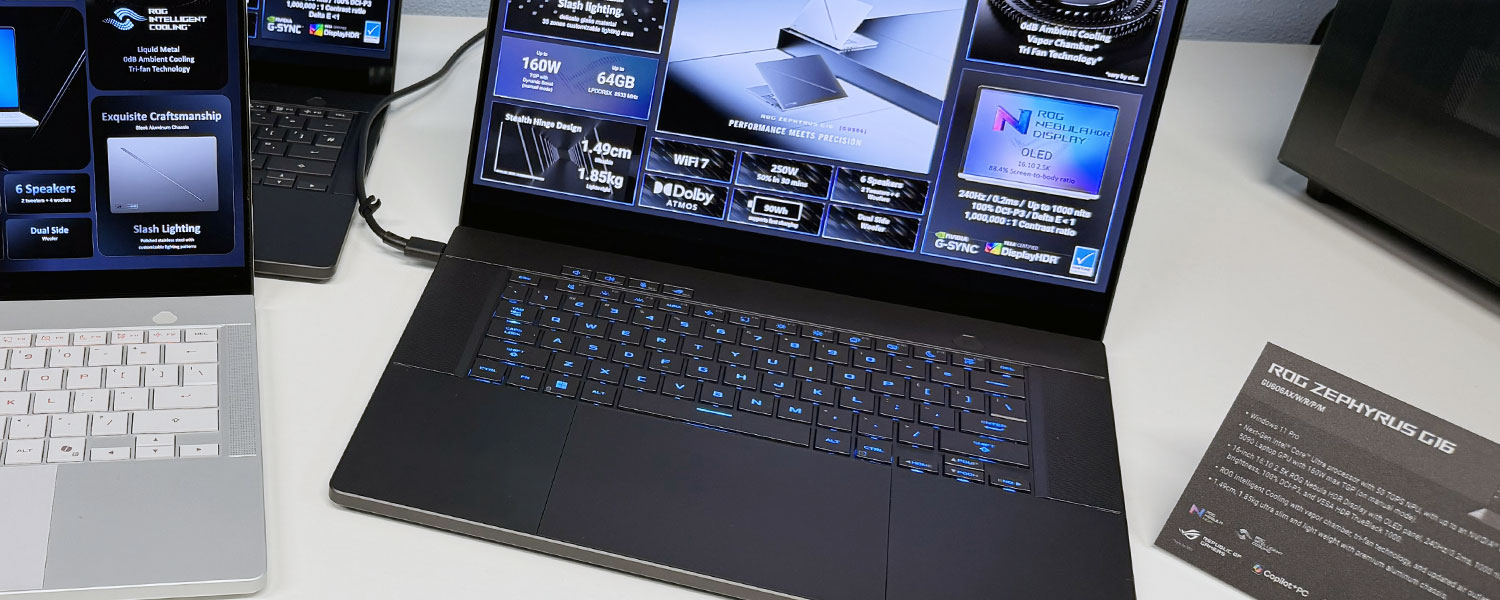
Asus are updating their ROG Zephyrus G16 popular series of portable high-performance laptops for 2026, and we’ll discuss the novelties in this article.
We’ve reviewed all the ROG Zephyrus notebooks launched over the years, so we know where this series could have been improved. But most of the 2026 changes are incremental refinements, as this generation is mostly built on the same chassis with the same features and ergonomics.
Among the important changes is the addition of a much brighter OLED display and a bump in hardware specs and power: a Panther Lake Core Ultra 9 platform paired with RTX 5000 graphics, up to an RTX 5090 at 160W TGP – that’s much higher than on the 2025 Zephyrus G16 and ProArt P16 models, and nearly on par with full-power implementations at 175W TGP.
Here’s a specs sheet for the 2026 Zephyrus, next to the 2025 model, and then we’ll get more indepth further down.
2026 ASUS ROG Zephyrus G16 GU606, vs. 2025 Zephyrus G16 GU605
| 2025 ASUS ROG Zephyrus G16 GU605CR – official page | 2025 ASUS ROG Zephyrus G16 GU605CR | |
| Display | 16-inch, 16:10, glossy, non-touch, OLED 2.5K 2560 x 1600 px , 240 Hz VRR 0.2ms, ~500 nits SDR, ~750 nits sustained HDR, 1100-nits peak HDR, 100% DCI-P3 colors |
16-inch, 16:10, glossy, non-touch, OLED 2.5K 2560 x 1600 px , 240 Hz VRR 0.2ms, 400 nits SDR, 600-nits peak, 100% DCI-P3 colors |
| Processor | Intel Panther Lake H, Core Ultra 9 386H, 16C/16T |
Intel Arrow Lake H, Core Ultra 9 285H, 16C/16T |
| Video | Arc + up to Nvidia RTX 5090 24GB (up to 160W with Dyn Boost) with MUX, Advanced Optimus, and GSync |
Arc + up to Nvidia RTX 5090 24GB (up to 120W with Dyn Boost) with MUX, Advanced Optimus, and GSync |
| Memory | up to 64 GB LPDDR5x-8533 (onboard) | up to 32 GB LPDDR5x-7467 (onboard) |
| Storage | 1x M.2 PCIe gen5 and 1x gen4 | 2x M.2 PCI 4.0 x4 slots |
| Connectivity | WiFi 7 2×2 with Bluetooth 5.4 (Intel) | WiFi 7 2×2 with Bluetooth 5.4 (Intel) |
| Ports | left: DC-in, HDMI 2.1 FRL, 1x USB-C Thunderbolt 4.0, 1x USB-A 3.2, audio jack right: 1x USB-A 3.2, 1x USB-C gen2 (with data, DP, PD), SD UHS-II card reader |
left: DC-in, HDMI 2.1 FRL, 1x USB-C Thunderbolt 4.0, 1x USB-A 3.2, audio jack right: 1x USB-A 3.2, 1x USB-C gen2 (with data, DP, PD), SD UHS-II card reader |
| Battery | 90 Wh, 250 W power adapter, USB-C charging up to 100W | 90 Wh, 240 W power adapter, USB-C charging up to 100W |
| Size | 354 mm or 13.96” (w) x 246 mm or 9.68 (d) 14.9 -16.4 mm or .59” – .65″ (h) for 5060/5070 chassis 14.9 – 17.9 mm or .59” – .70″ for 5070Ti+ chassis |
354 mm or 13.96” (w) x 246 mm or 9.68 (d) x from 14.9 mm or .59” (h) |
| Weight | from ~1.95 kg (4.3 lbs) for the 5070Ti-5090 version, from ~1.85 kg (4.1 lbs) for the 5060-5070 version, .75 kg (1.65 lbs) for the 250W main power brick and cables, EU version |
from 2.1 kg (4.65 lbs) for the 5090 version, .72 kg (1.58 lbs) for the 240W main power brick and cables, EU version |
| Extras | clamshell format with 130-degree hinge, redesigned hinge mechanism, premium design and updated lighting bar on the lid, with 35 light zones, single-zone RGB keyboard and large glass touchpad, 6x speakers – 10W, FHD webcam with IR, available in silver (Platinum White) or gray (Eclipse Gray) variants |
clamshell format with 130-degree hinge, premium design and Slash lighting bar on the lid, single-zone RGB keyboard and large glass touchpad, 6x speakers – 10W, FHD webcam with IR, available in silver (Platinum White) or gray (Eclipse Gray) variants |
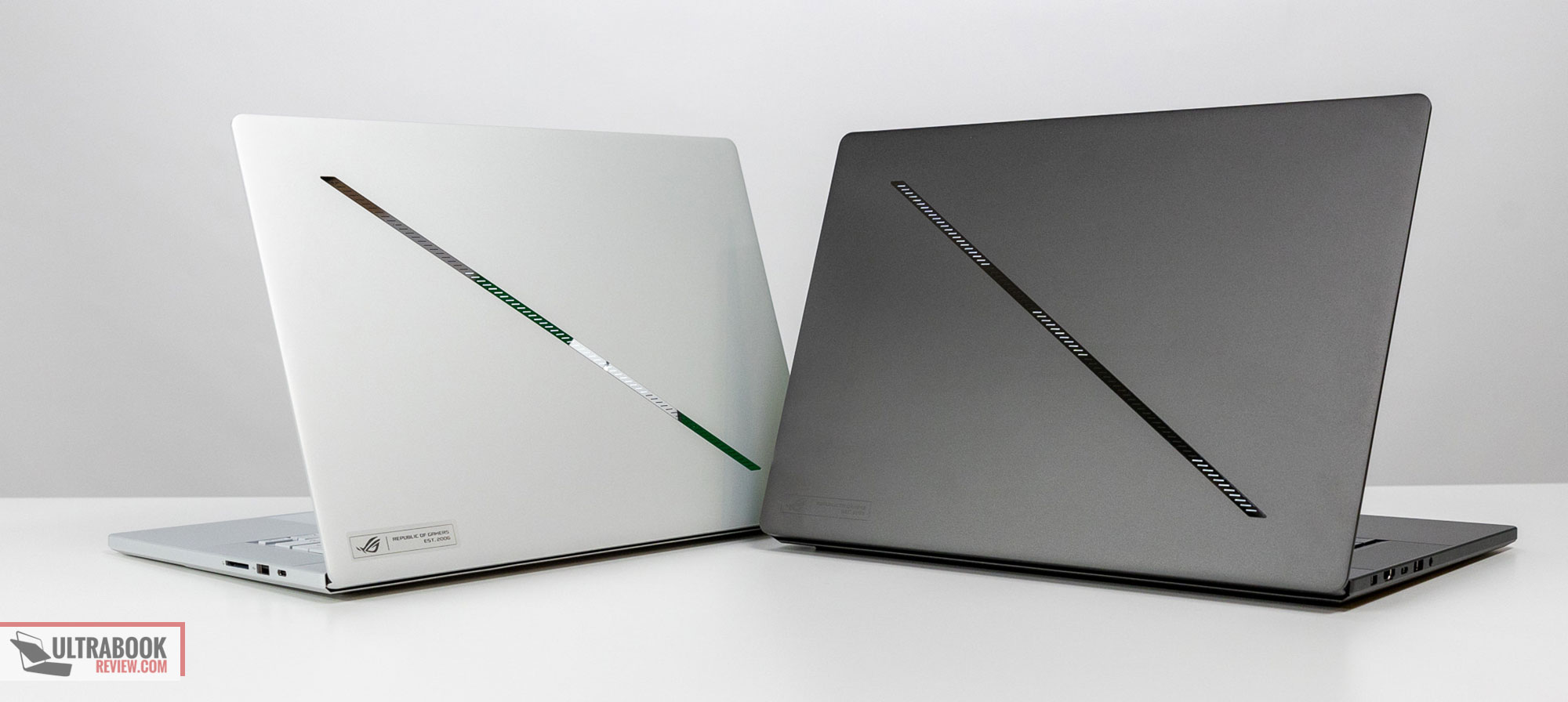
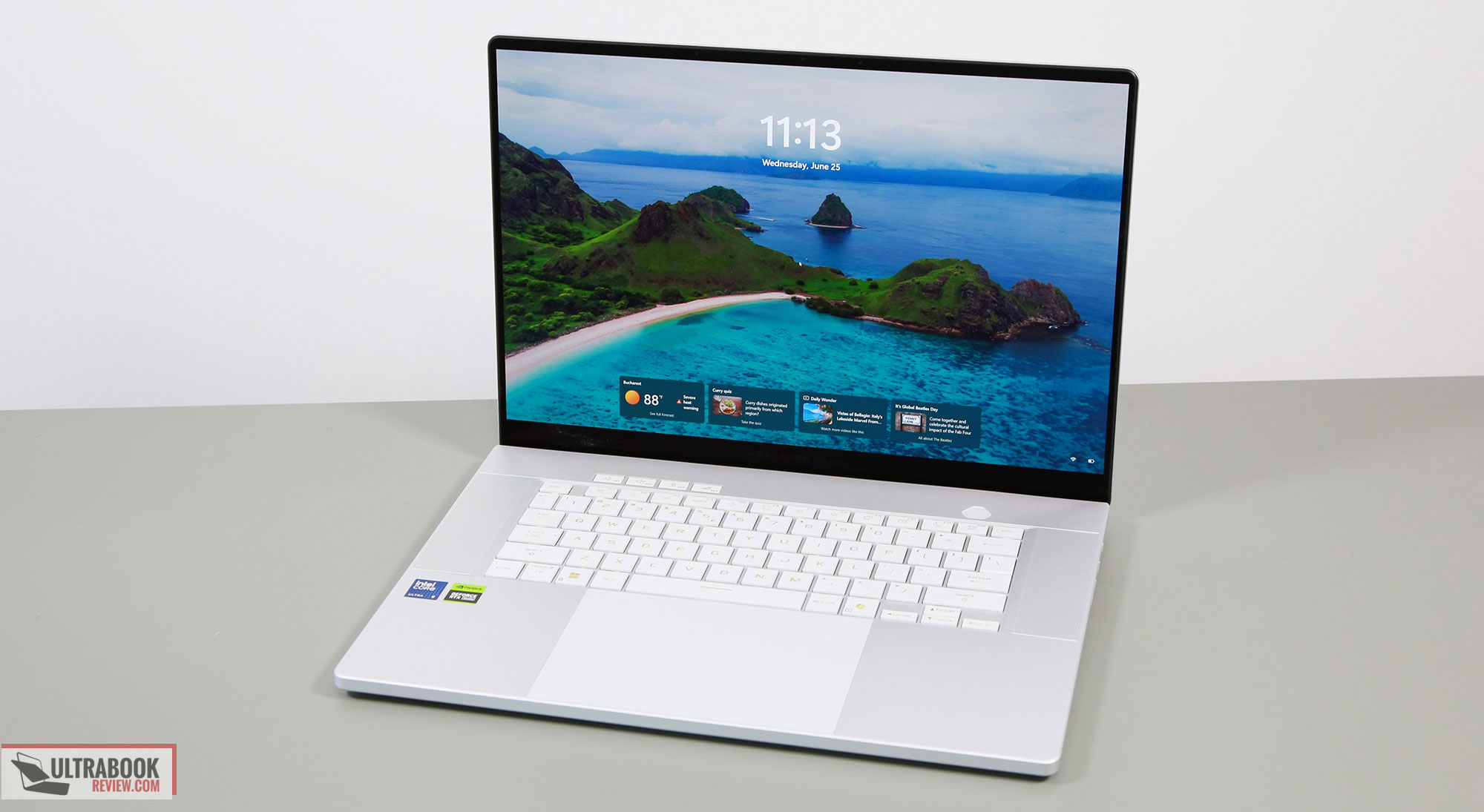
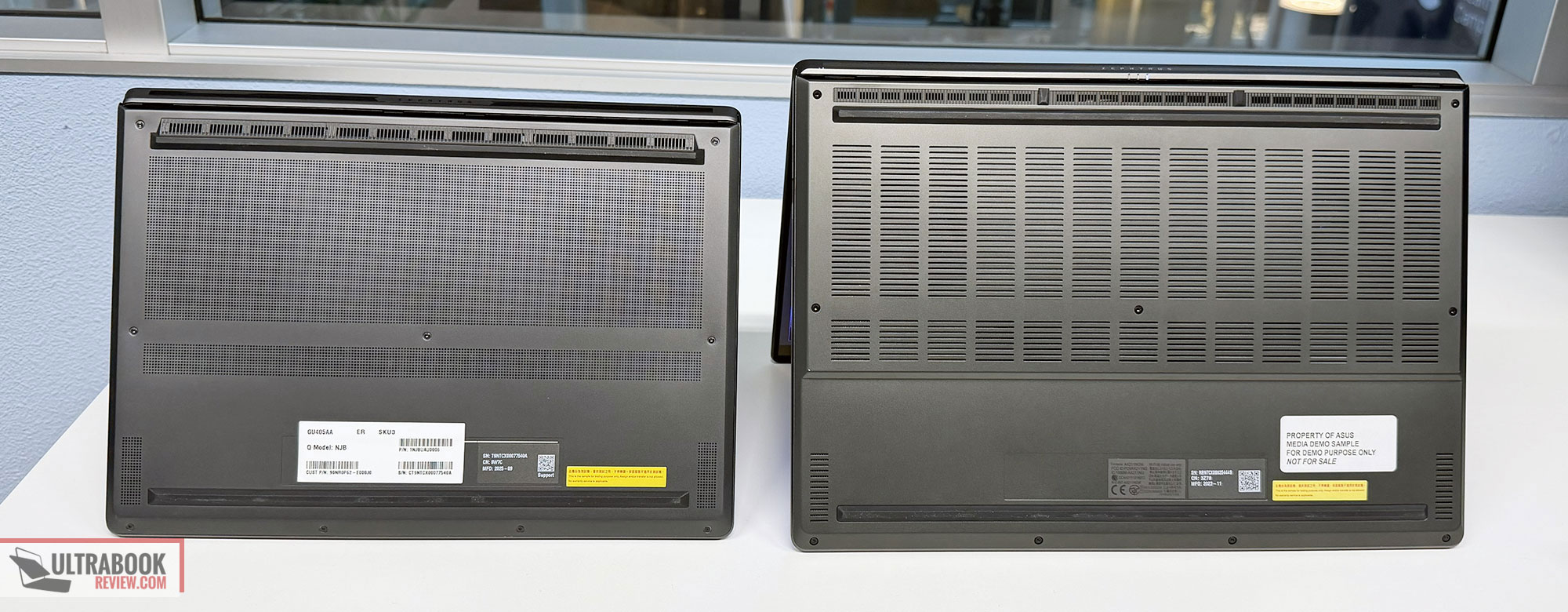
As mentioned earlier, the 2026 and 2025 Zephyrus G16 models share the same premium unibody chassis, arguably among the better-feeling options in the Windows space today.
Aesthetically, Asus are offering the two in either a lighter gray or a darker-gray variant. Both have this Slash Lighting bar of LEDs on the lid, with the 2026 generation offering an updated implementation with more control zones (the same number of LEDs, but each controlled individually now, while in the past they could only be controlled in groups). I still wish they had gotten rid of it entirely; the lid would look much cleaner in a simpler design, as it does on the ProArt P16, which is the same chassis but in an all-black minimalist approach. Regardless, it is what it is.
Another incremental update for the 2026 generation are the updated hinges, which adjust torque throughout the opening motion – it should make the hinges softer when lifting up the display, and then progressively tighten them to keep the display in place at the open angles. I didn’t have an issue with the way the hinges worked in the past, but rather with how there’s no notch on the front lip and how the open angle is limited to only 130 degrees. These aspects haven’t changed.
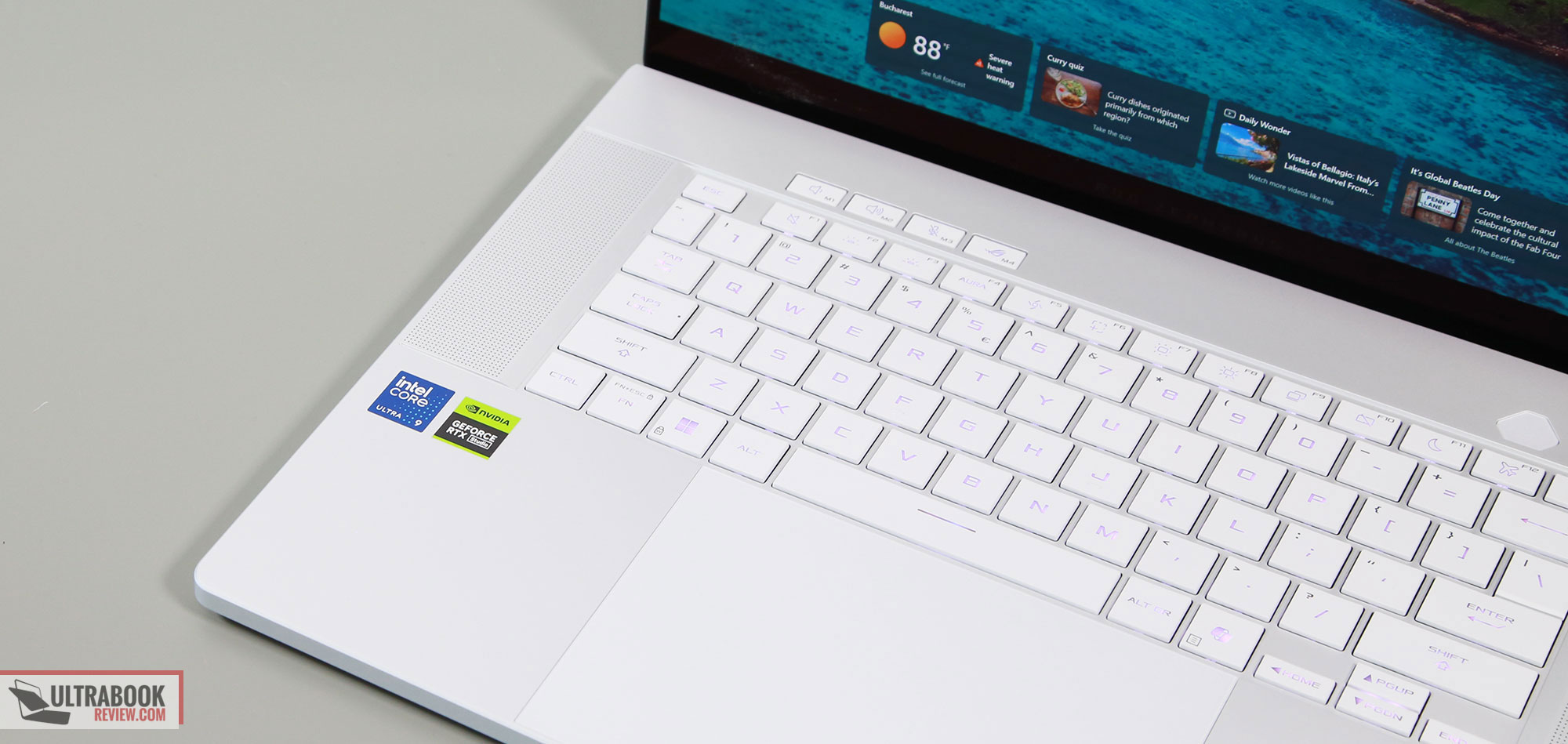
That’s mostly because the general chassis layout hasn’t changed, with the cooling still entirely placed on the rear edge – but the internal cooling module has been revamped – more on that in a bit. That also means the keyboard is still rather minimalist, centered on the case and without a NumPad, but flanked by some of the best speakers available on Windows devices today. And the IO is lined around the edges, with all the right ports, including USB-Cs on both sides and an SD card reader.
Here are some images of the Zephyrus G16 chassis.

And a few more side-by-sides images of the G16 next to the smaller G14, both the 2026 refreshes.
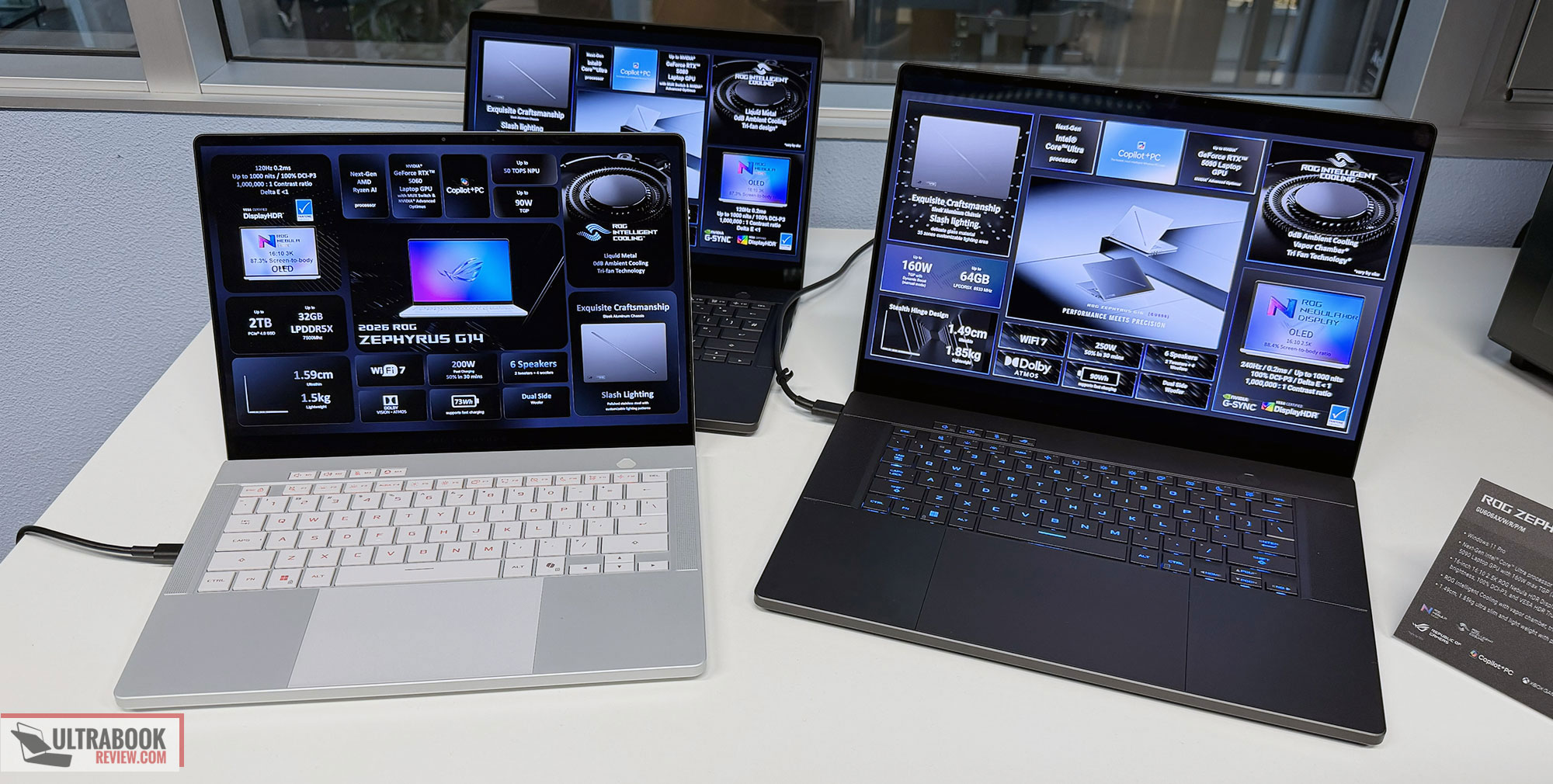
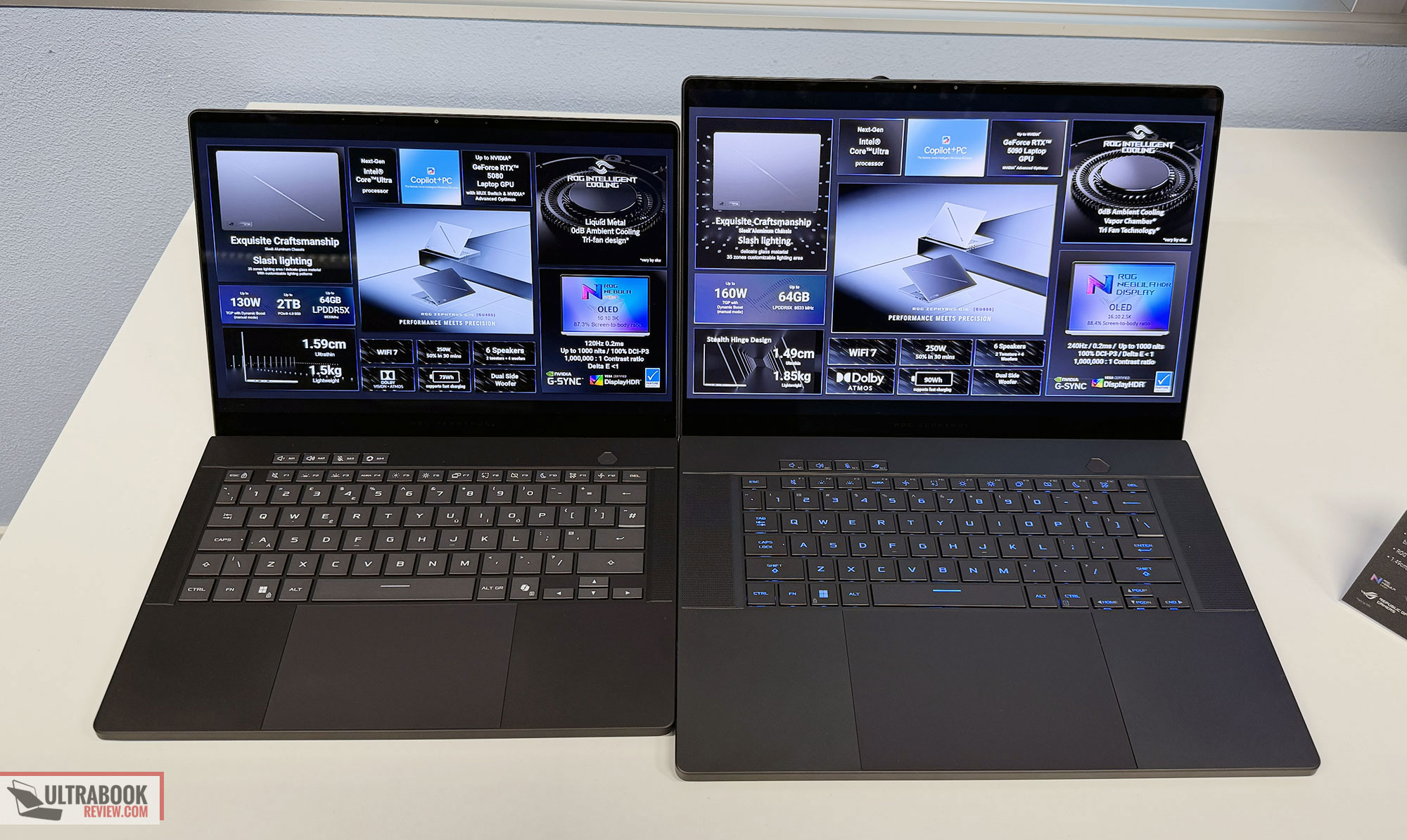
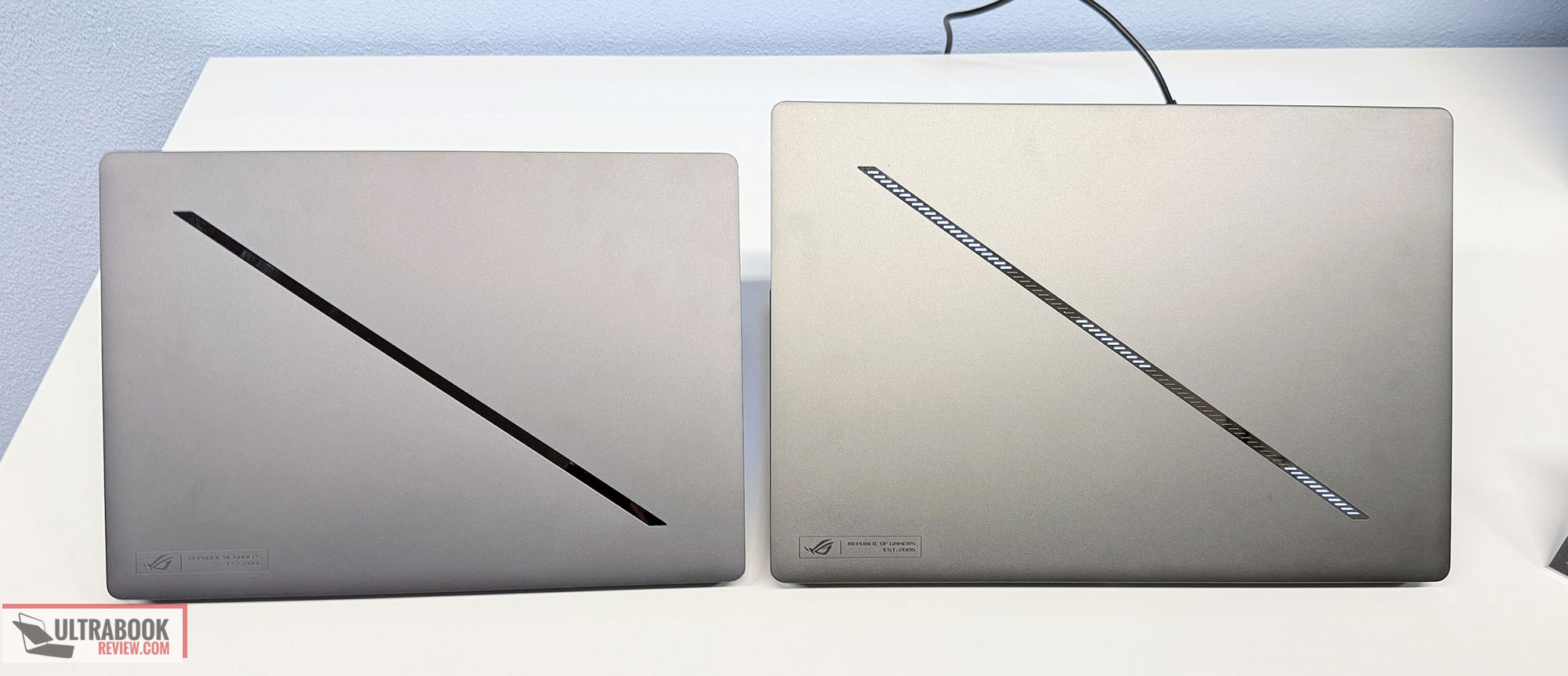
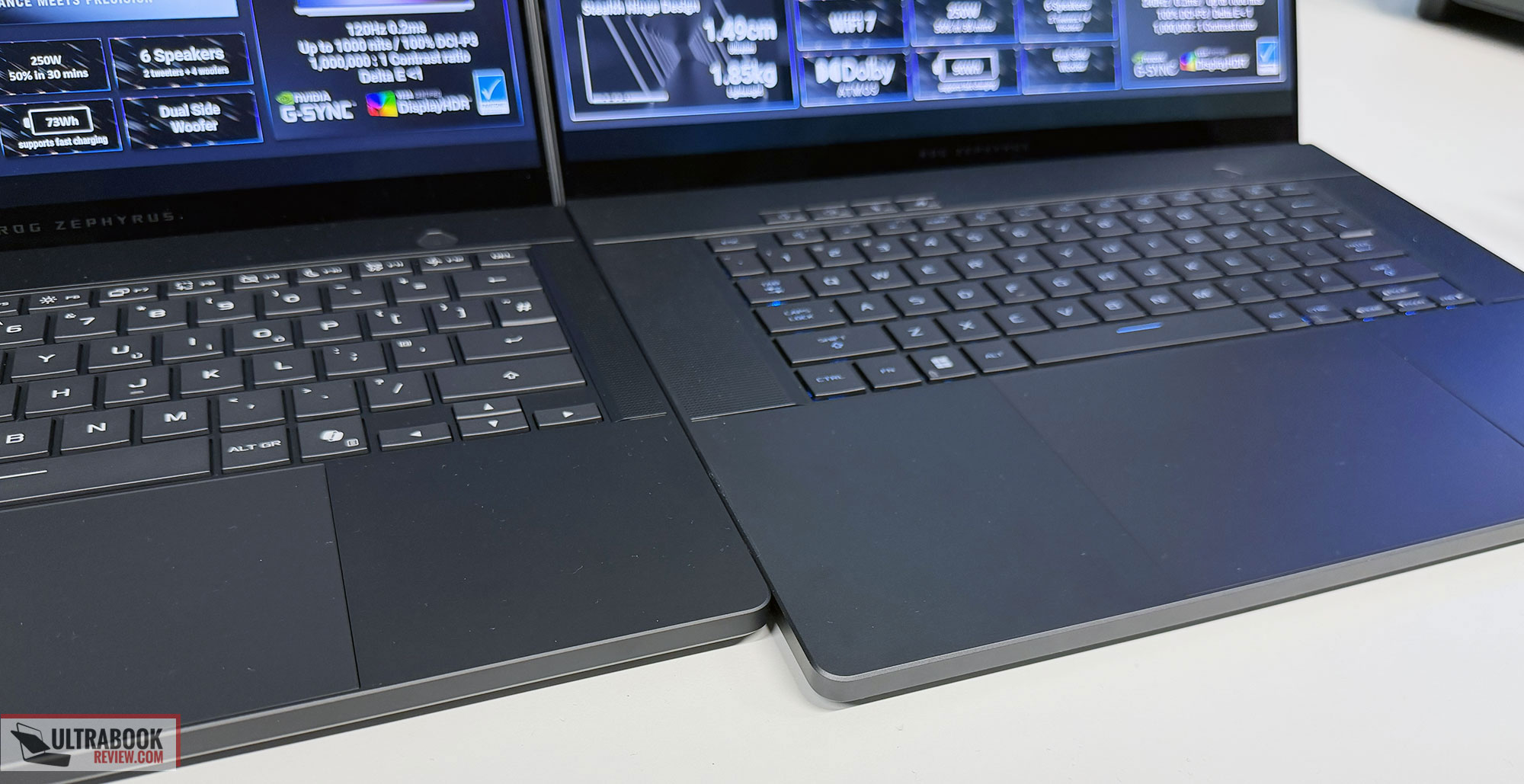
And then we get to that new display, a latest-generation OLED from Samsung, and it’s a regular OLED, not a Tandem OLED. It allows for higher sustained and peak brightness levels, up to 1100-nits peak, making the laptop more usable in brighter lighting conditions and improving the HDR capabilities in videos and games. At the same time, it’s still 2.5K resolution with 240Hz refresh and 0.2ms response, VRR and GSync, so excellently suited for gaming. We’ll have to test for any tradeoffs, though, such as flickering or burning due to the higher brightness levels.
The other novelties are on the inside, where the hardware has been updated to Intel’s latest Panther Lake Core Ultra Series 3 platform, up to a Core Ultra 9 H processor. That’s paired with up to 64 GB of LPDDR5x-8533 memory and SSD storage (with one gen5 slot), plus various upper-tier RTX 5000 GPUs, up to an RTX 5090.
Over the last G16 generations, Asus offered two variants of this notebook: a thicker and heavier one with more advanced cooling for the higher-tier variants (5070Ti and higher for the 2025 models), and a thinner, lighter one with more basic cooling for the lower-tier models (5070 and lower). The upper-tier design gets a refresh for 2026, but I’m not sure these changes carry over to the lower-tier chassis as well – we’ll update when we know more.
The upper-tier models provided up to 140W crossload power on the 2025 G16s, with up to 115W TGP on the GPU. The 2026 refresh bumps the power to 175W crossload, with 160W TGP on the GPU. That’s a major update, and I believe that was made possible by an updated thermal module with a larger vapor-chamber and a thicker overall profile that allows for extra space inside.
I’m looking forward to testing the overall performance gains and general thermal behavior of this updated generation – I do expect up to 20% gains in sustained loads, with higher temperatures than in the past. However, as long as you kept the laptop raised off the desk, both internal and external temperatures were excellent on the 2025 models, so there’s a potential headroom for higher thermals that can be properly exploited here.
For what it’s worth, if you’re interested in an AMD iteration of this notebook, that’s not offered with the Zephyrus chassis, but rather with the Asus ProArt P16 (which is not receiving an update to Gorgon Point hardware, but that’s not an issue given how measly of an upgrade a Ryzen 9 AI HX 470 offers over a Strix Point Ryzen AI 9 HX 370).
All in all, while the 2026 Zephyrus G16 might not look like much of an update on a first look, the brighter display and the refreshes in CPU/GPU/RAM/SSD combined make it a notably more powerful notebook than the 2025 generation.
That’s about it for now, but look forward to our detailed reviews of this refreshed 2026 Zephyrus G16 GU606 series over the next few weeks. These laptops should be available in stores quickly in the first months of the year, but expect some hefty prices, further bumped up by the current RAM/SSD situations. Expect most notebooks to demand a premium this year over their predecessors at launch, and that would put the top-specced 5090 model over 4K USD/4.5K EUR.









Koten
January 7, 2026 at 2:46 pm
There is no specification about 750 nits in SDR. IDK where did you got those numbers. Samsung specify on their website that new V6 models will have 500 nits in SDR – which is most likely will be present in current G16 2026
Andrei Girbea
January 7, 2026 at 2:55 pm
Right, that was a mistake in the specs. You're right, SDR brightness is around 500 nits, what I was referring to is sustained brightness on a full 100% white screen on HDR, which should be around 700-750 nits.
I've edited the specs. Thanks for the heads up
Claudio
January 31, 2026 at 3:35 am
Is there any release date?
Andrei Girbea
February 2, 2026 at 12:56 pm
within a few weeks. I don't have an exact date